Cabin Design
The Chestnut Hideaway | 900 Sq Ft Cabin Plans with 3 Bedroom Layout
About the Chestnut Hideaway
3
1
900 Sq Ft
The Chestnut Hideaway is a single-story, three-bedroom cabin designed around shared living. not just compact efficiency. Its open-plan core, kitchen, dining, and lounge in one continuous space, gives the home a social scale that most cabins don't attempt at this size. A freestanding wood stove anchors the living zone, full-height sliding glass doors connect the interior to the surrounding landscape, and dark-stained cedar cladding gives the exterior a grounded, considered character. With a master bedroom, a guest room with its own deck access, and a single/study room, the design works for families, couples who host, and short-stay operators who want something with more presence than a standard two-room cabin.
Cabin Design Specifications
Dimensions
Imperial: 50ft x 18ft
Metric: 15.2m x 5.5m
Layout
3 Bed
1 Bath
Design Type
Cabin
Sleeps
Up to 5
4 Adults, 1 Guest
Plans/Blueprints Available
Plans Exported With:
Export with instant generate plans tool & Take off tool in 3D Designer
Design Walkthrough
The Design Concept Overview
Most cabin plans make a trade-off between bedroom count and livability. Add a third bedroom and something usually gives, the living room becomes a hallway, the kitchen shrinks to a galley you can barely turn around in, or the whole plan starts to feel like a floor plan exercise rather than a home worth spending time in.
The Chestnut Hideaway takes a different approach. At approximately 900 sq ft on a single storey, it's a three-bedroom cabin that puts social quality ahead of spatial efficiency. The open-plan core, kitchen, dining, and lounge, is designed to feel generous, not just functional.
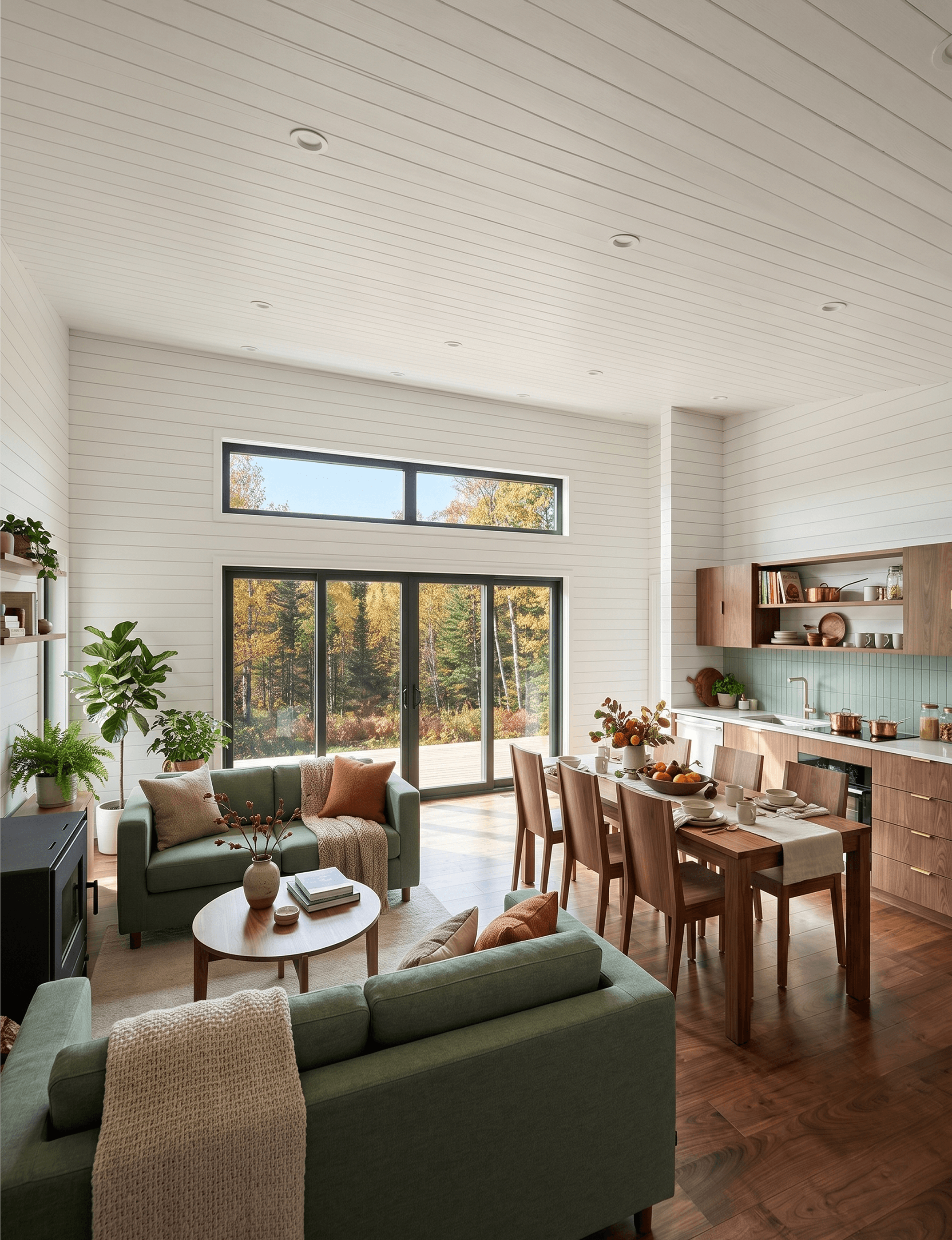
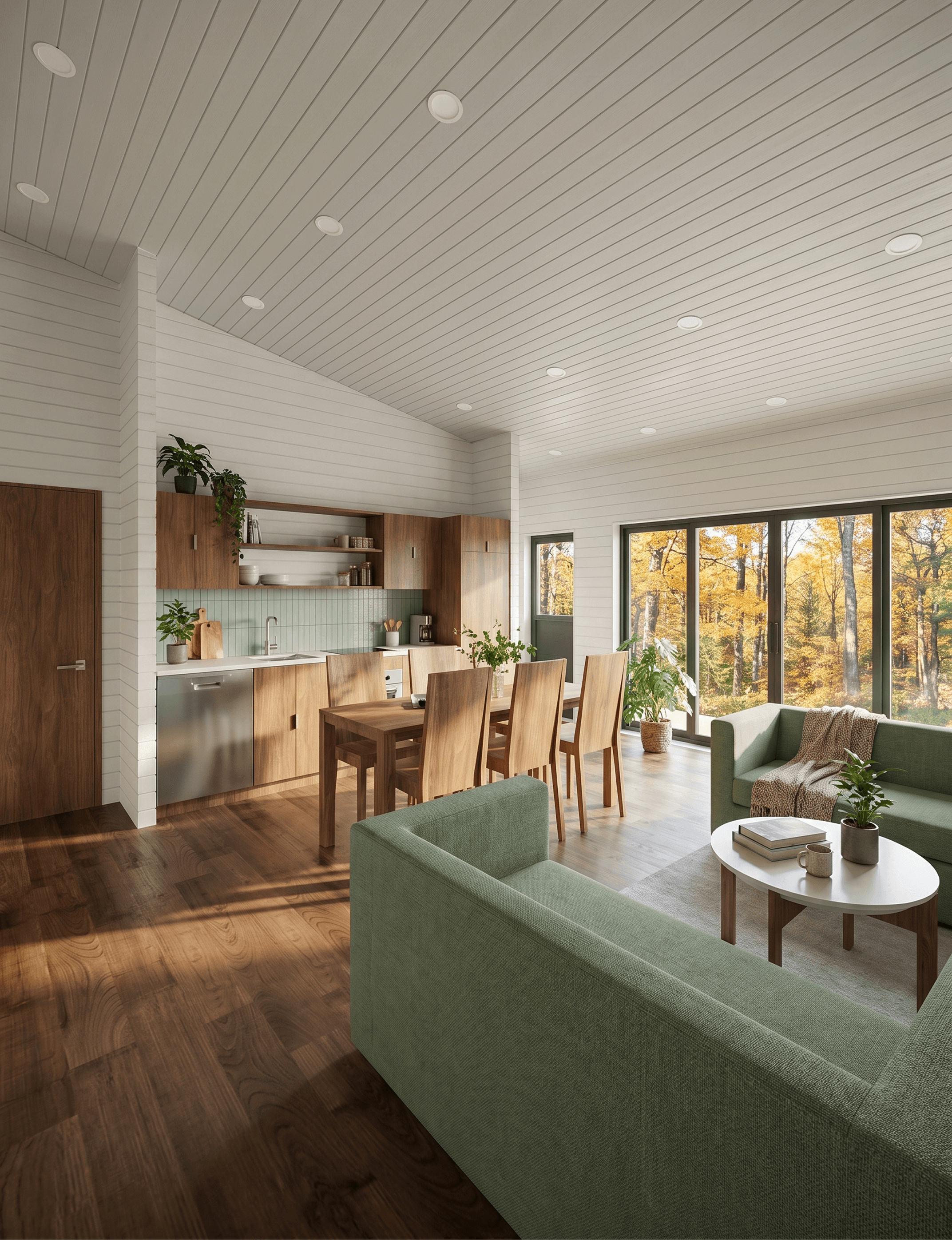
A freestanding wood stove sits at the heart of the living zone, dual green sofas face each other across a low coffee table, and a walnut dining table seats six. This isn't a cabin where the living room was an afterthought. It's the reason the design exists.
The aesthetic is warm and grounded without leaning into the rustic clichés of traditional cabin design. Dark-stained cedar cladding wraps the exterior in deep charcoal-brown timber. Inside, cream shiplap walls and ceilings carry that warmth through every room, while walnut cabinetry, brass hardware, and sage-green tiles add colour and character without overcrowding the palette.
The design suits buyers who want the setting and mood of a cabin without giving up the livability and guest capacity of a small home. It's a 3 bedroom cabin plan that works across a wider range of use cases than most designs at this size.
Buyer | Why it Works |
|---|---|
Small families | 3 bedrooms with a living core sized for daily use not just weekends |
Holiday home buyers | Guest room with its own deck access keeps visitors comfortable without crowding the main living zone |
Short-stay operators | 3 bedrooms, integrated laundry, and strong design quality support a premium nightly rate |
Remove works or long stays | Built-in desk in the third room handles work-from-cabin use without needing a dedicated office |
The Exterior: A 900 Sq Ft Cabin Plan in Dark Cedar
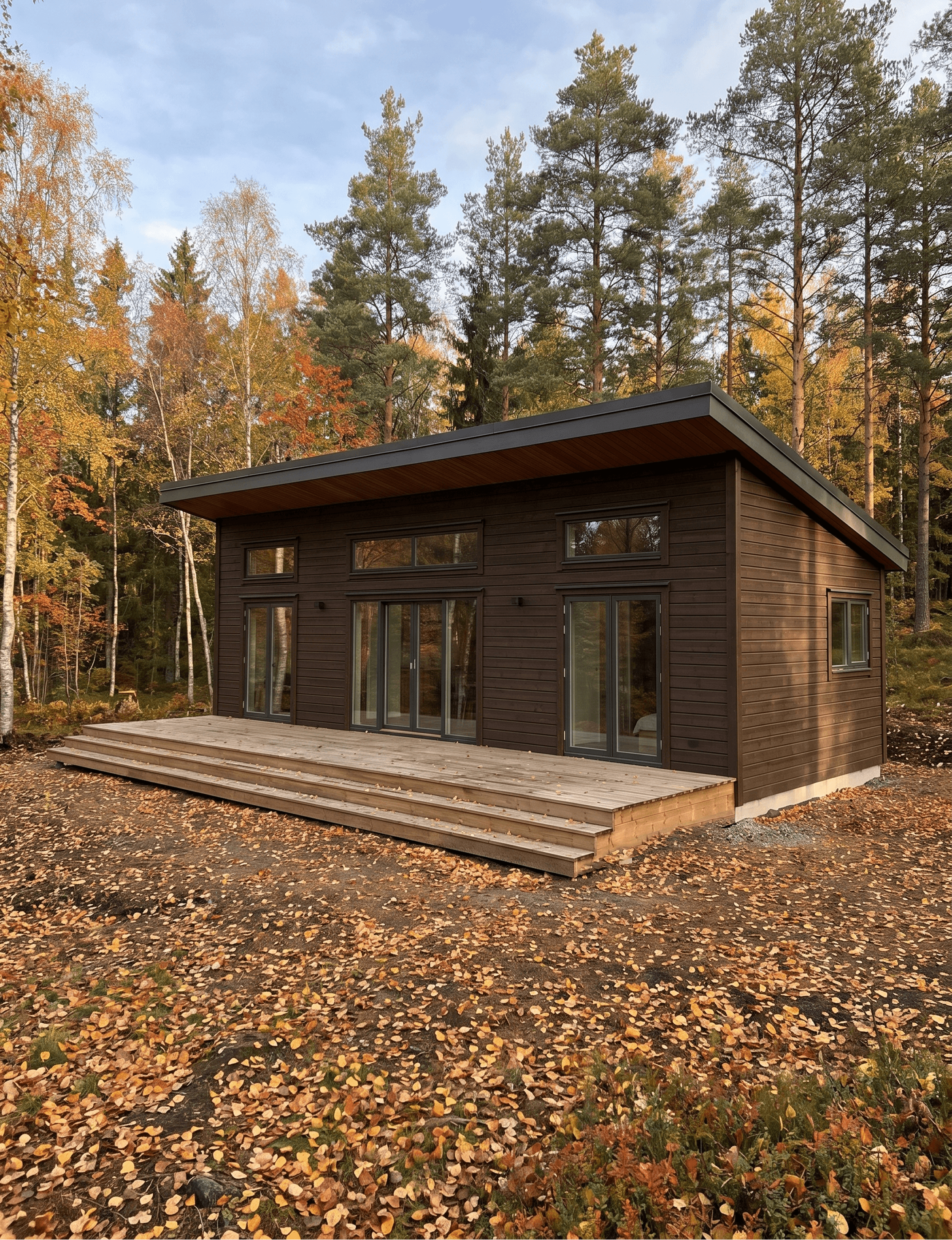
The Chestnut Hideaway's exterior makes its statement through material and form rather than complexity. The building is a long, low rectangle with a mono-pitched roof, a single sloping plane that defines the silhouette cleanly and creates a semi-sheltered outdoor zone at the front through an extended overhang.
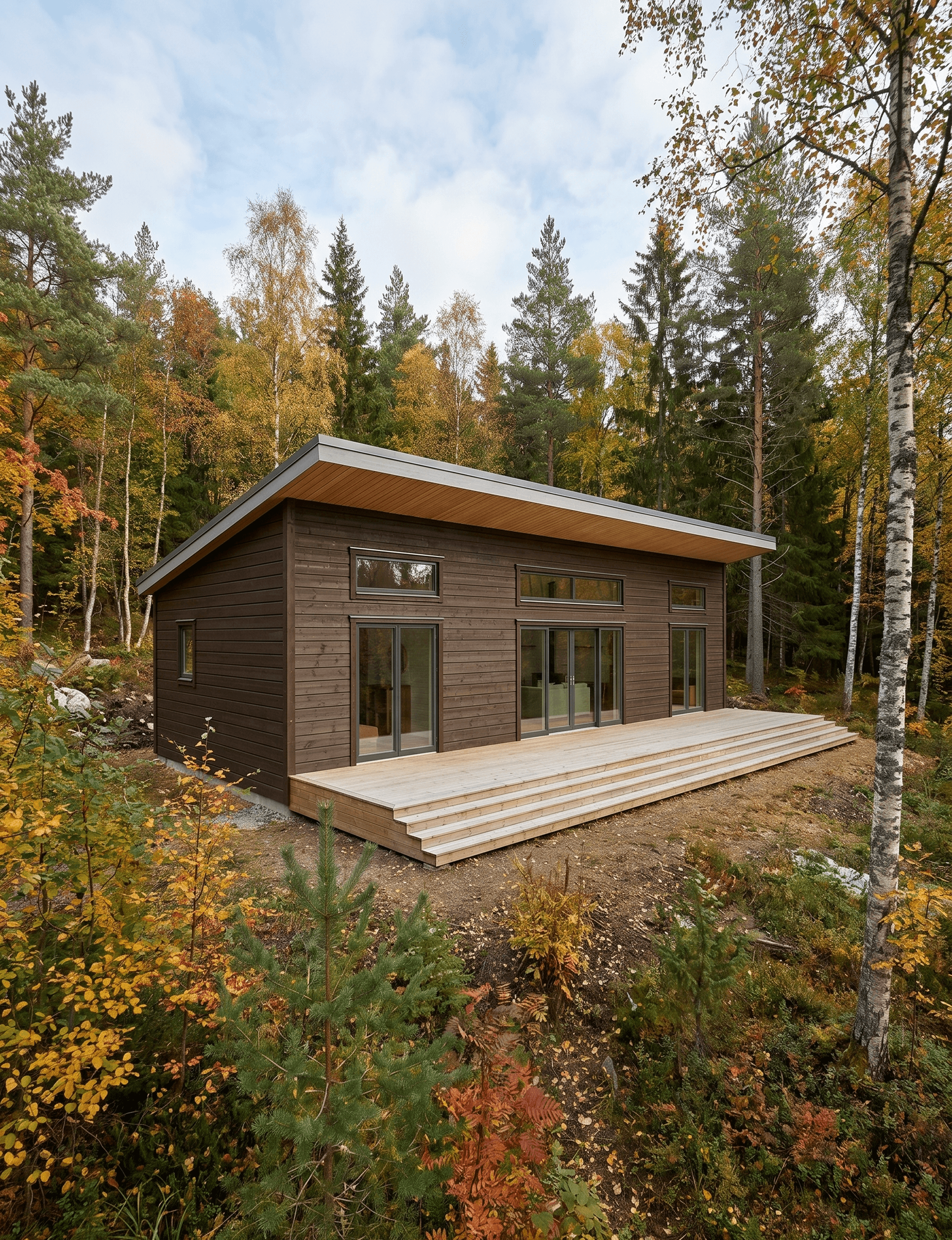
Dark-stained horizontal timber cladding covers the exterior across all four elevations. It reads as a deep brown-charcoal in natural daylight, and it gives the cabin a weight and presence that lighter or lighter-toned finishes wouldn't achieve. The soffits beneath the overhang are finished in a lighter cedar tone, providing a warm contrast that breaks up the darker body and draws attention to the transition between roof and wall. Black-framed windows and sliding glass doors carry the dark palette forward without adding another colour to the mix.
The front facade is the most open elevation:
Multi-pane sliding glass doors span a significant portion of the front wall, offering a wide connection between the interior and the deck outside.
A clerestory strip window runs above the sliding doors, bring additional light into the open-plan zone without disrupting the wall composition.
A natural timber deck with stepped entry extends from the front, creating an outdoor zone that benefits form the overhang above.
A wood stove flue pipe exits through the roofline at the rear, marking the heart of the home from the outside.
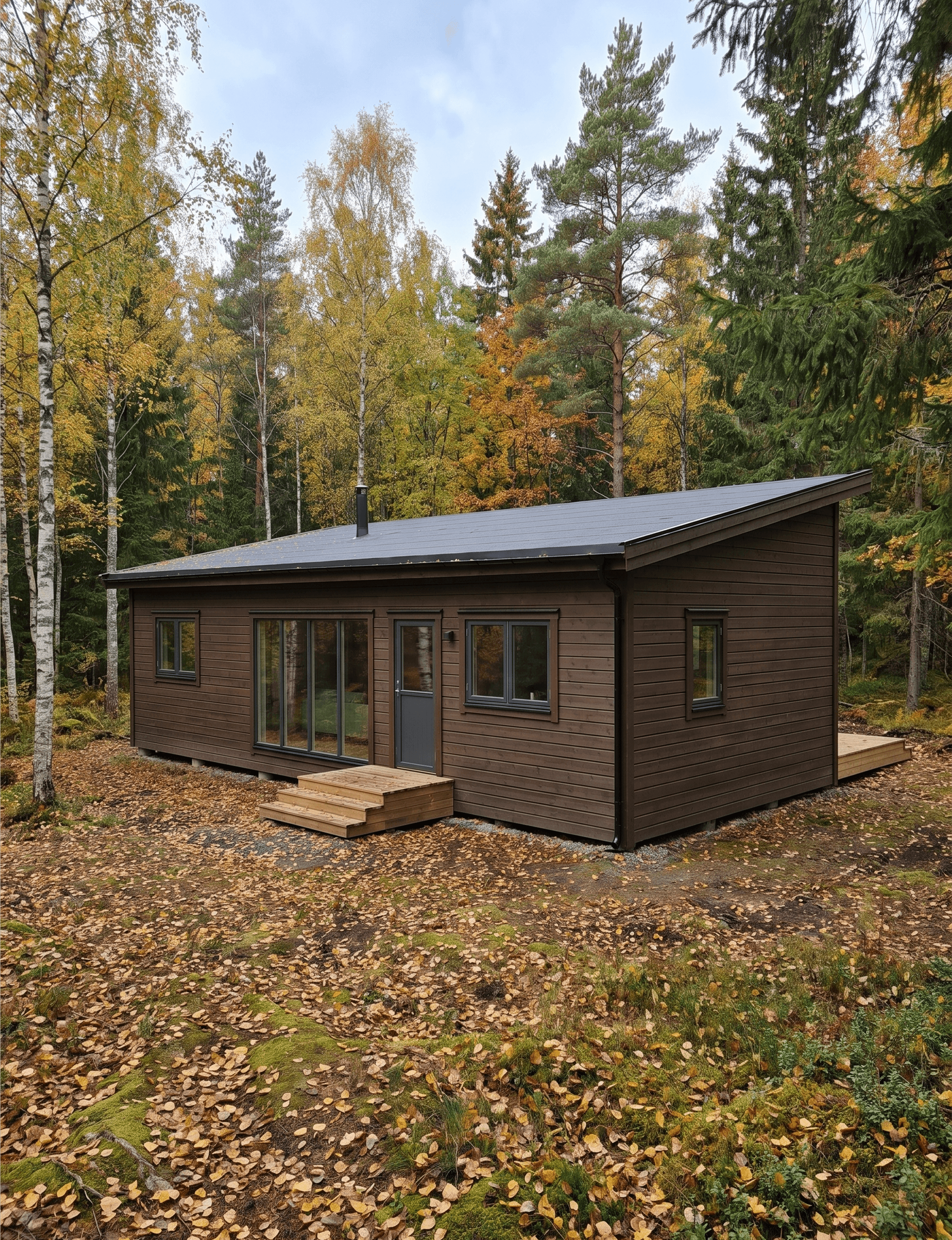
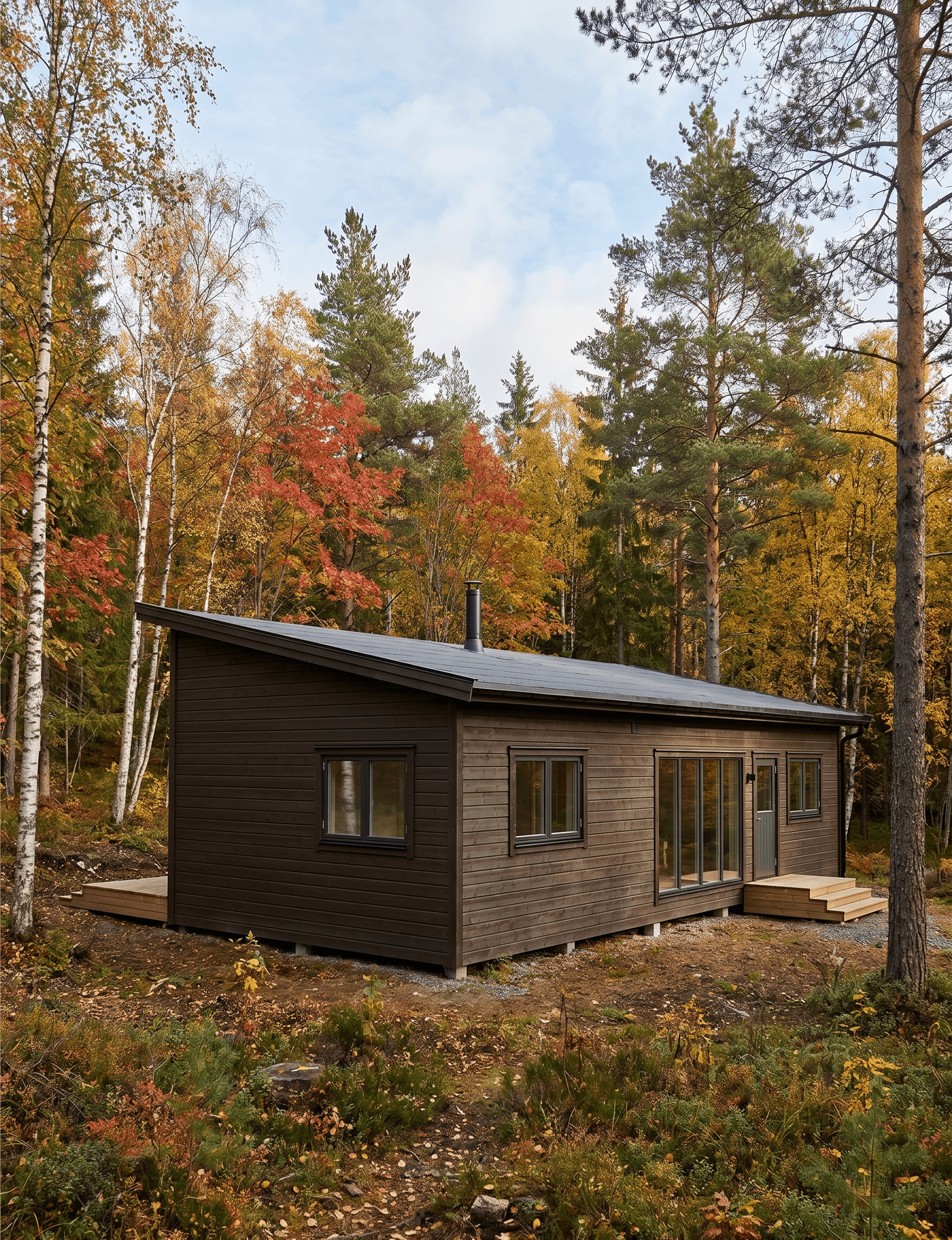
The rear elevation is more closed, with smaller individual windows sort into the dark cladding. This creates a natural orientation to the design, the front is social and connected to the outdoors, the rear is private and sheltered. For rural, bush, or forested settings with a view or aspect worth capturing, that orientation works well.
The Kitchen & Dining
The kitchen runs along one side of the open-plan core as a single-wall layout, a clean, contained run of cabinetry that sits parallel to the living zone without dividing the space. It's a functional kitchen sized for real cooking and shared meals, not a galley designed to save floor space.
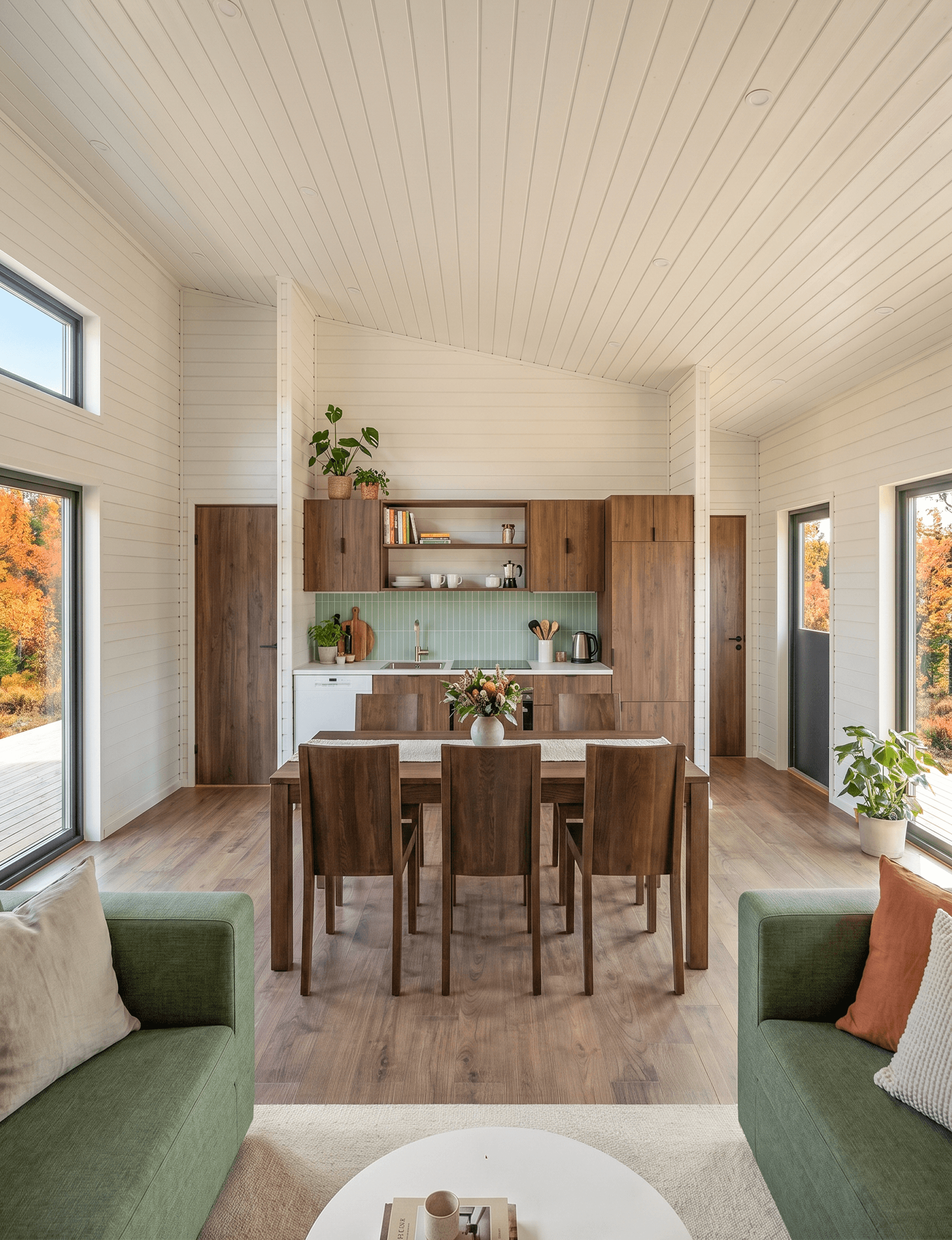
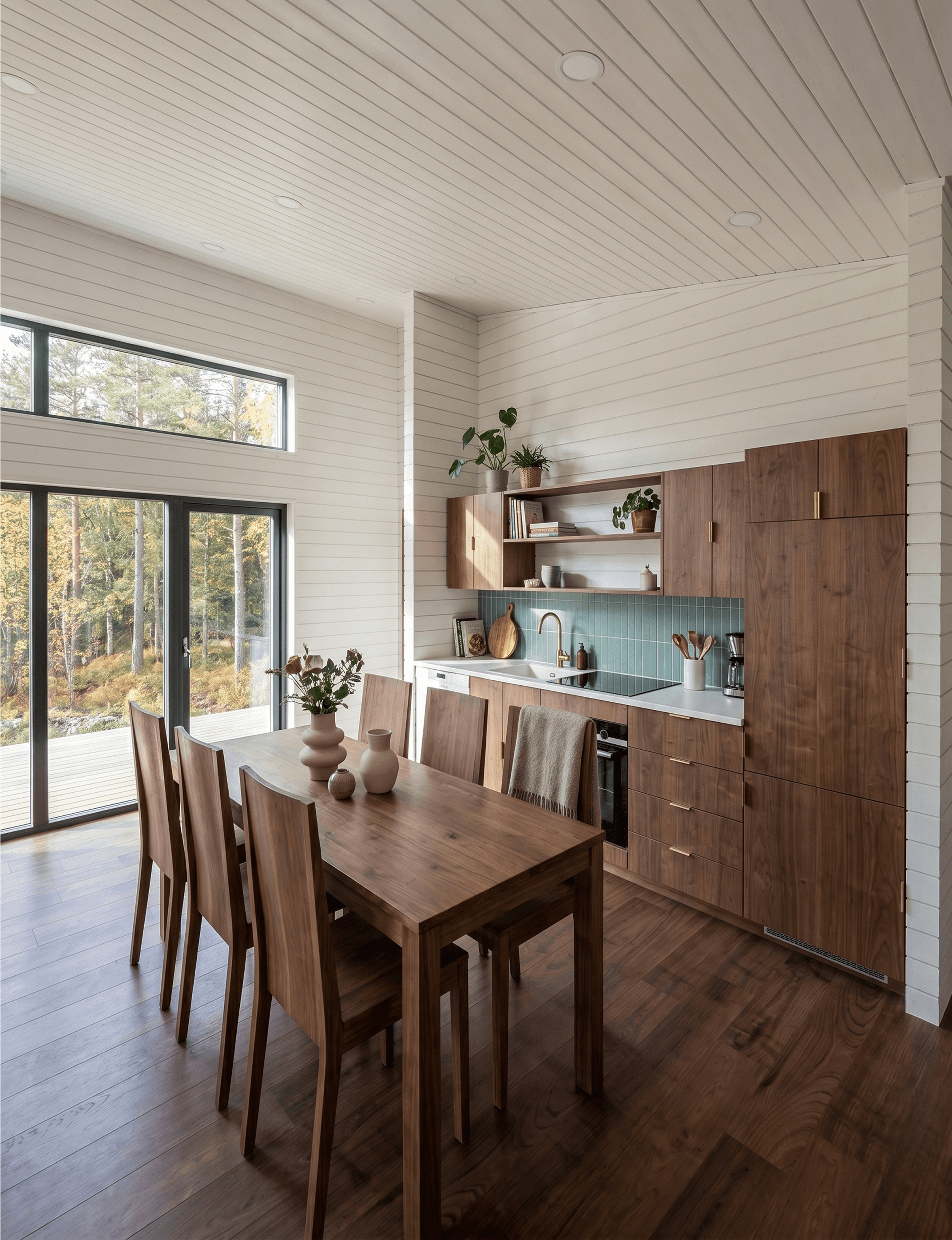
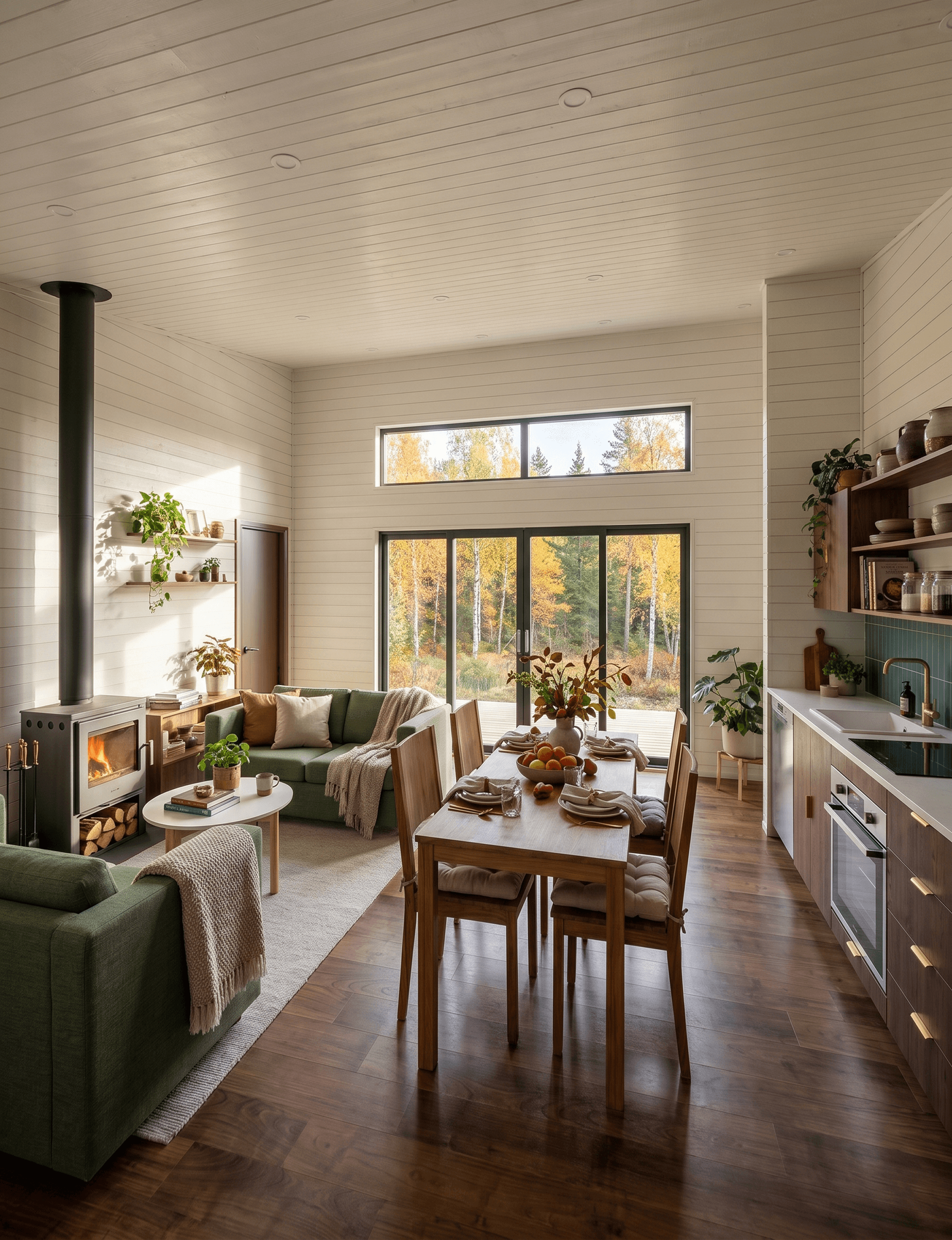
The cabinetry's walnut-toned flat-panel throughout, with a full-height run from floor to ceiling, open shelving alive the counter for everyday items, and brass hardware on every door and drawer. The bench top is a stone-look surface that reflects the light coming in from the sliding glass doors. Behind the cooking zone, a sage-teal tile backsplash in a subtle vertical format adds the main point if color in the kitchen without competing with the rest of the palette.
What the kitchen and dining zone includes:
Walnut flat panel cabinetry with full-height doors and brass hardware throughout.
Sage-teal tile backsplash behind the counter, a warm muted green that ties to the bathroom and sofa tones elsewhere — in the home.
Open timber shelving above the counter zone for accessible everyday storage.
Stone-look bench tops that reflect natural light from the glazing.
Large black-framed sliding glass door to one side, bringing the natural light into the dining zone throughout the day.
The dining table is a solid walnut piece that seats six comfortably. It sits close enough to the kitchen to make serving easy, and close enough to the living area to keep the room feeling connected rather than split into separate zones. For a 900 sq ft cabin plan that needs to work for families or groups, that open relationship between kitchen, dining, and lounge is one of the more important design decisions in the whole floor plan.
The Living Area: Social Space at the Centre of This 900 Sq Ft Cabin Plan
The living zone is positioned as the anchor of the open-plan core, not as a leftover space at the end of the kitchen run. A freestanding wood stove with a tall black flue pipe sits at its heart, not pushed into a corner, but placed as a deliberate social focus that the rest of the furniture is arranged around.
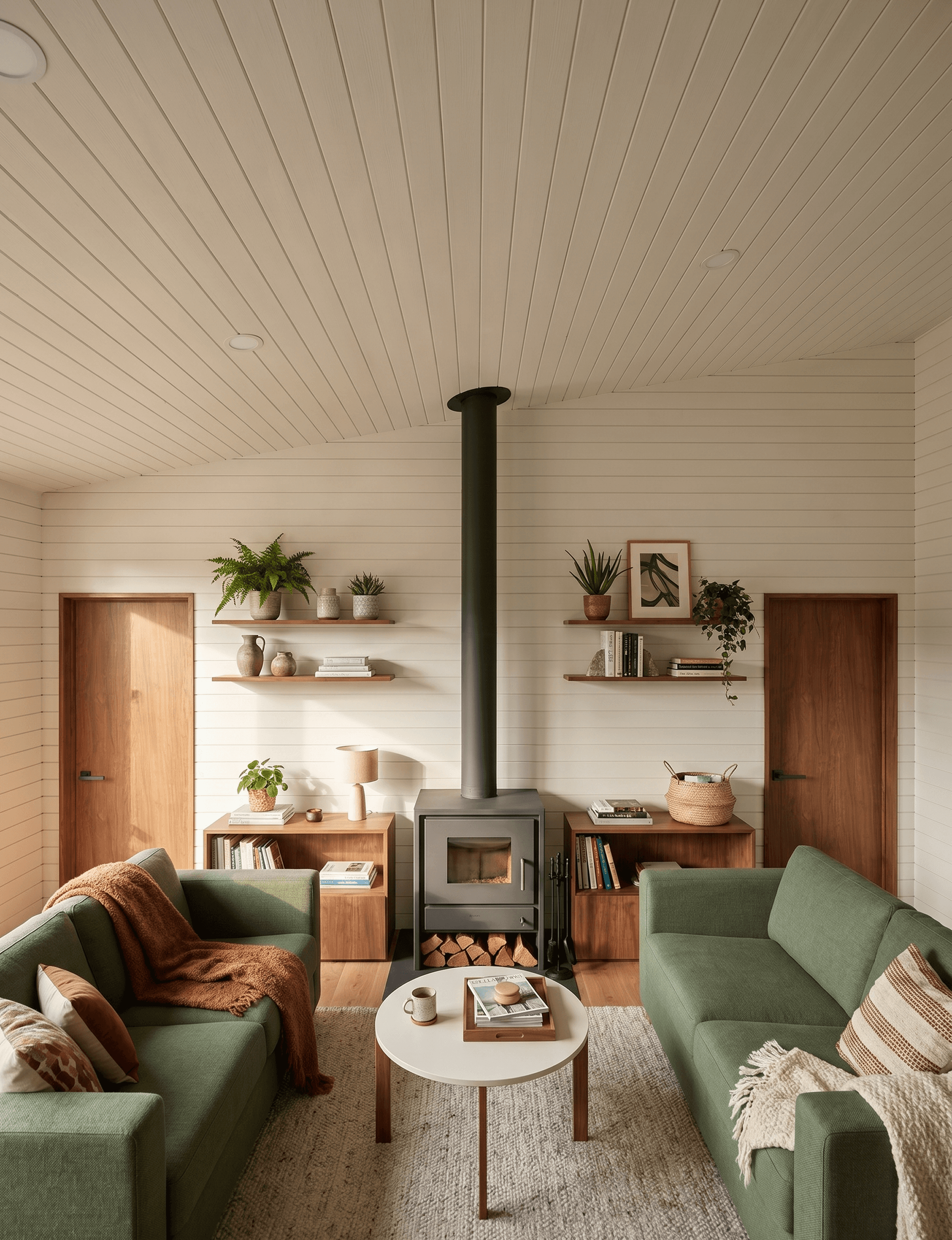
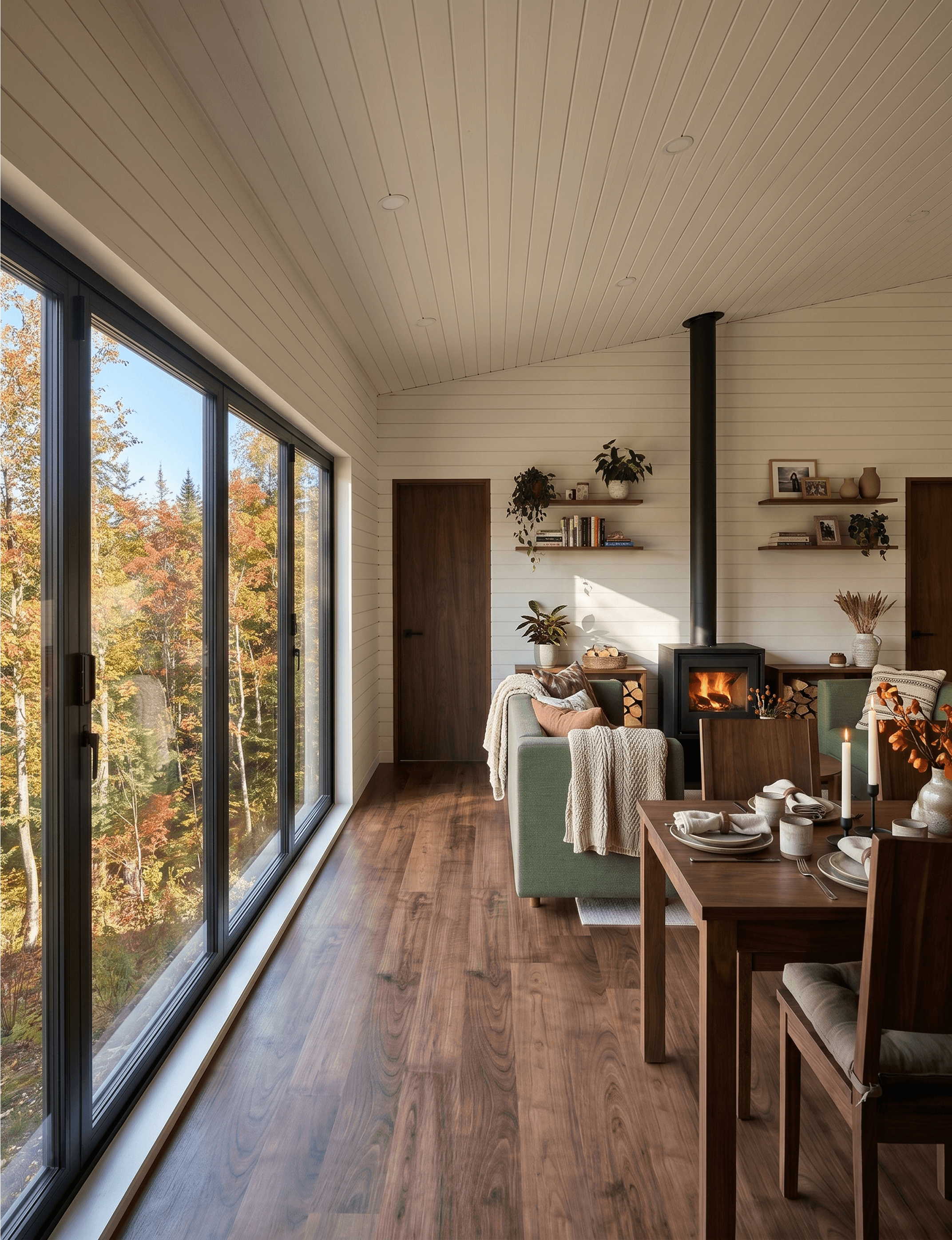
Two green sofas face each other across a low round coffee table, creating a configuration designed for conversation and shared evenings rather than solo TV watching. Open timber shelving on the surrounding wall holds plants, books, and everyday objects in a way that gives the room personality without cluttering it.
On the opposite side of the space, full-height black-framed sliding glass doors open onto the front deck. When the doors are fully open, the lounge effectively extends outside, which makes the total living footprint feel significantly larger than the floor plan suggests. A clerestory strip window above the sliding doors sits near the top of the wall, pulling additional light into the room from a high angle throughout the day.
Key elements of the living room:
Freestanding wood stove as the social anchor, black casing, tall black flue pipe, placed centrally in the rom.
Two green/sage upholstered sofas arranged to face each other, with a low coffee table between them.
Open timber shelving along one wall, plants, books, and display objects.
Full-height sliding glass doors connecting directly to the front deck
Clerestory strip window above the sliding doors for additional high-angle daylight.
Medium-dark Harwood flooring throughout, consistent with the kitchen and dining room.
The room has good nadirs light from multiple directions, front facing glazing to the deck and side-facing glazing in adjacent zones. It's a living space that works for quiet evenings in the same way it works for social gatherings, which is the right balance for a design that;s meant to be genuinely lived in.
The Bathroom
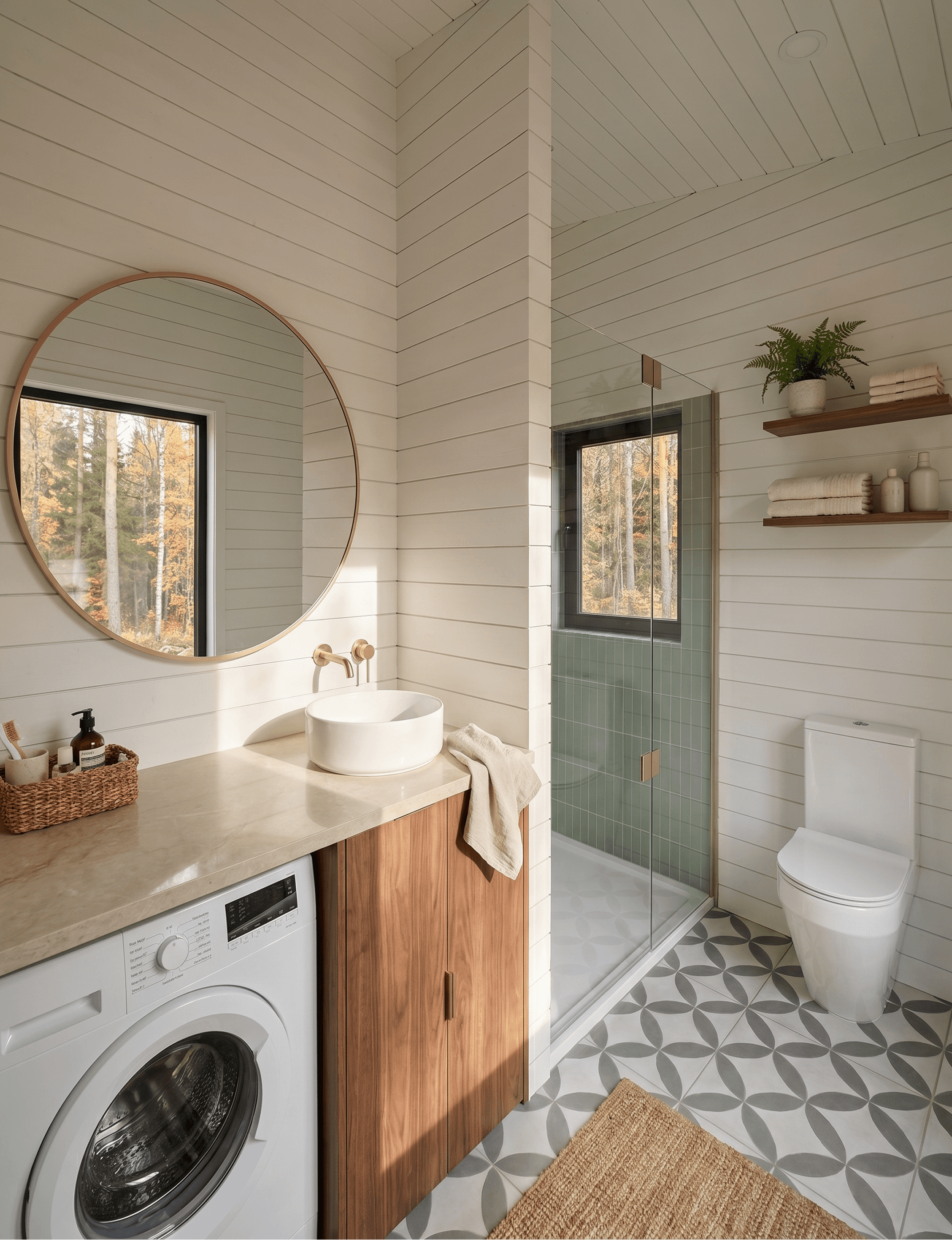
The bathroom in the Chestnut Hideaway does more per square foot than a typical cabin bathroom. It includes a walk-in shower, a toilet, a vanity with an integrated washing machine beneath it, and a laundry function, all within a single room that still manages to feel considered rather than compressed.
The vanity uses a walnut timber cabinet with a stone or marble-look benchtop. A round vessel bowl sink sits on top, paired with a brass wall-mounted mixer tap. Above it, a round wood-framed mirror reflects light from the window to the side, which overlooks the surrounding forest and helps the room feel brighter and more spacious than a windowless space would. A floating timber shelf above the toilet holds towels, plants, and bathroom accessories without taking up floor space.
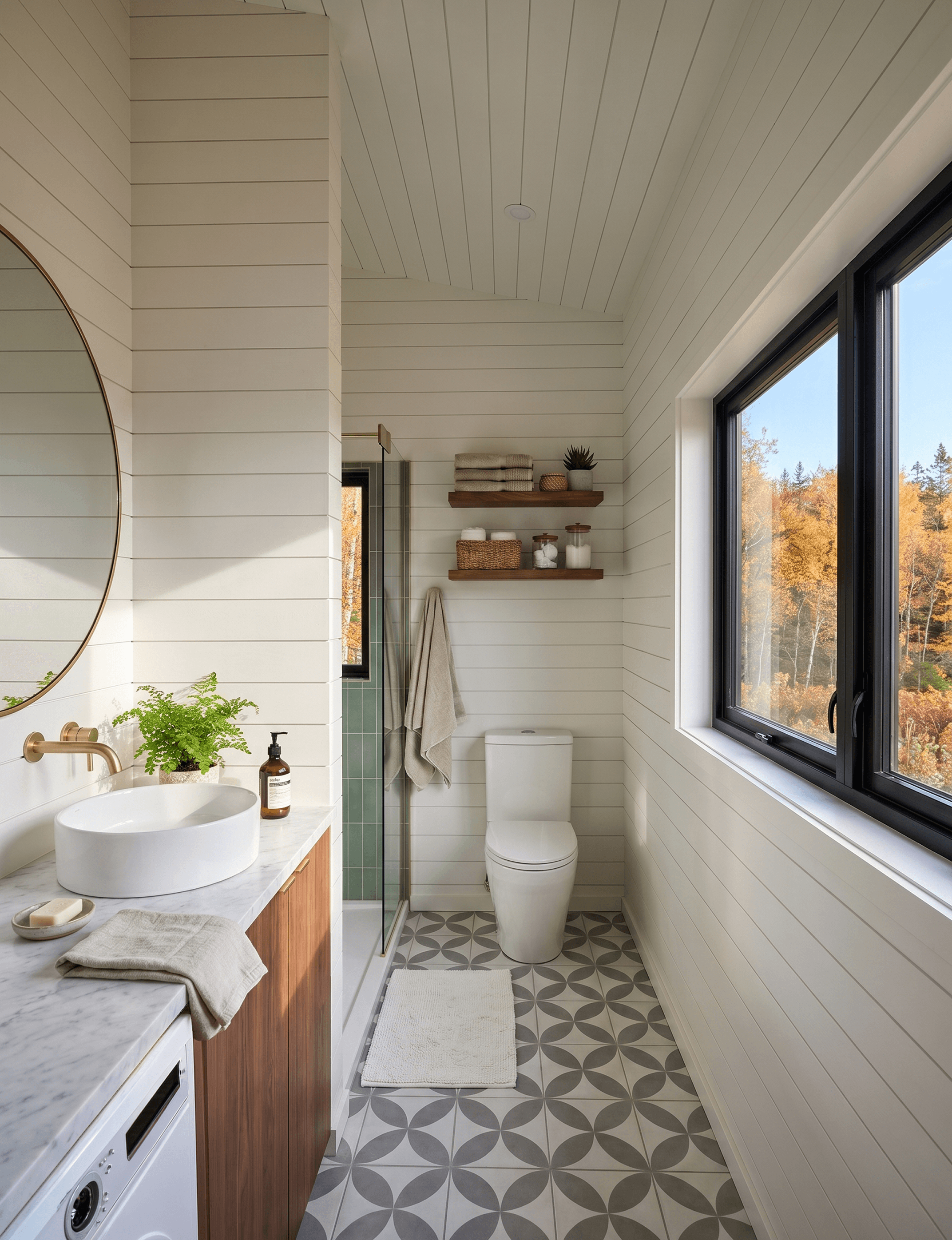
The washing machine is a front-loader integrated into the vanity cabinet below the sink, a practical decision that keeps laundry within the bathroom footprint rather than requiring a separate room or a hallway cupboard. For a three-bedroom cabin that's likely to be used by multiple people over extended stays, that integration matters.
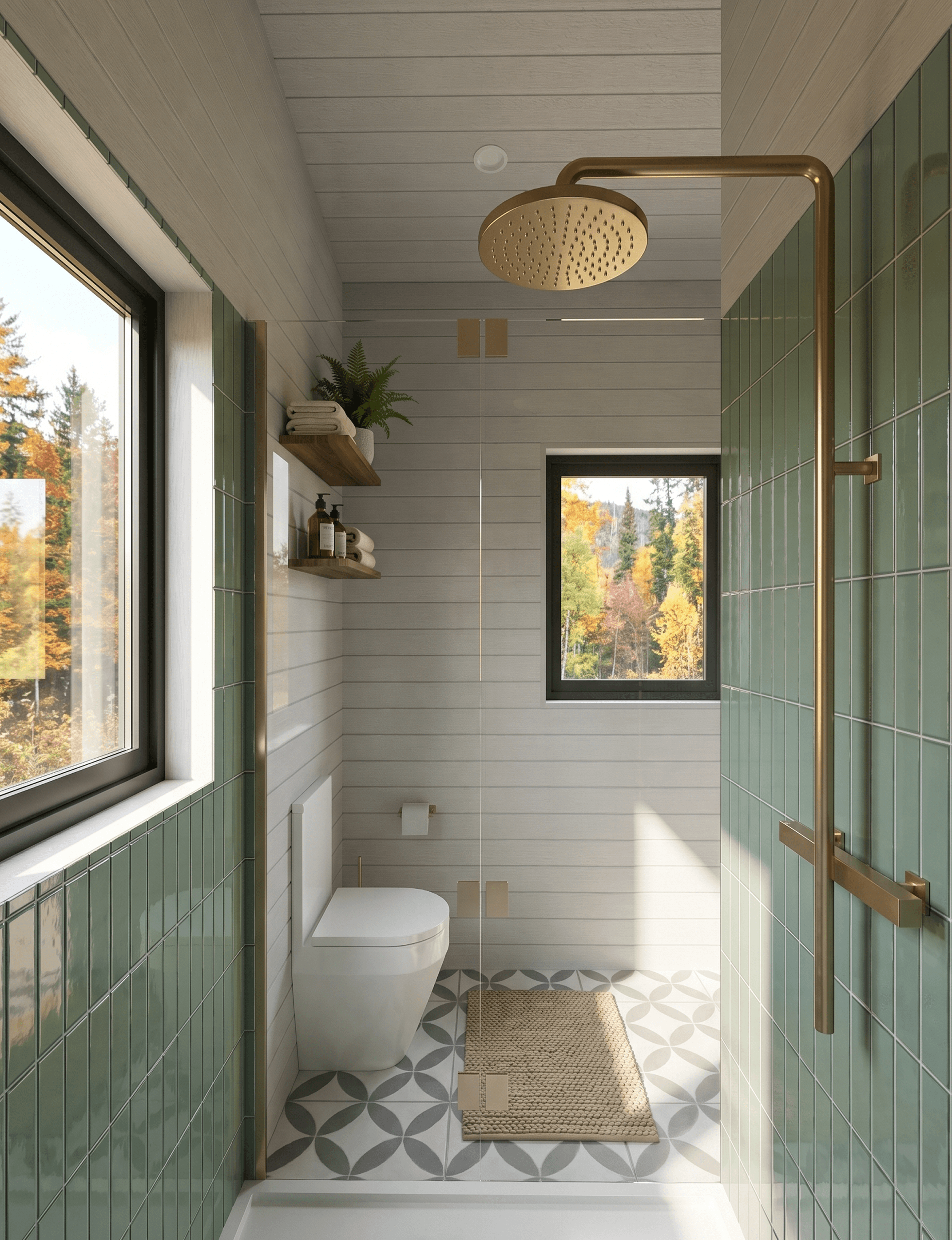
The shower is enclosed by a frameless glass screen and uses full-height sage-green tiles across the back wall, the same green tone that appears in the kitchen backsplash, creating a quiet material thread that runs through both rooms without feeling forced. The floor tiles are a patterned grey-white geometric design, adding visual interest at ground level without clashing with the rest of the palette. Tapware throughout is brass, consistent with the kitchen and consistent with the overall warmth of the home.
The Master Bedroom
The master bedroom's a calm, unhurried room. The walls and ceiling are the same cream shiplap as the rest of the home, and the dark timber floor grounds the space without making it feel heavy. Full-height sliding glass doors open to the forest outside, framing an autumn landscape through a black-framed door that spans most of the wall facing the exterior. A clerestory window above adds a secondary light source that shifts across the room through the day.
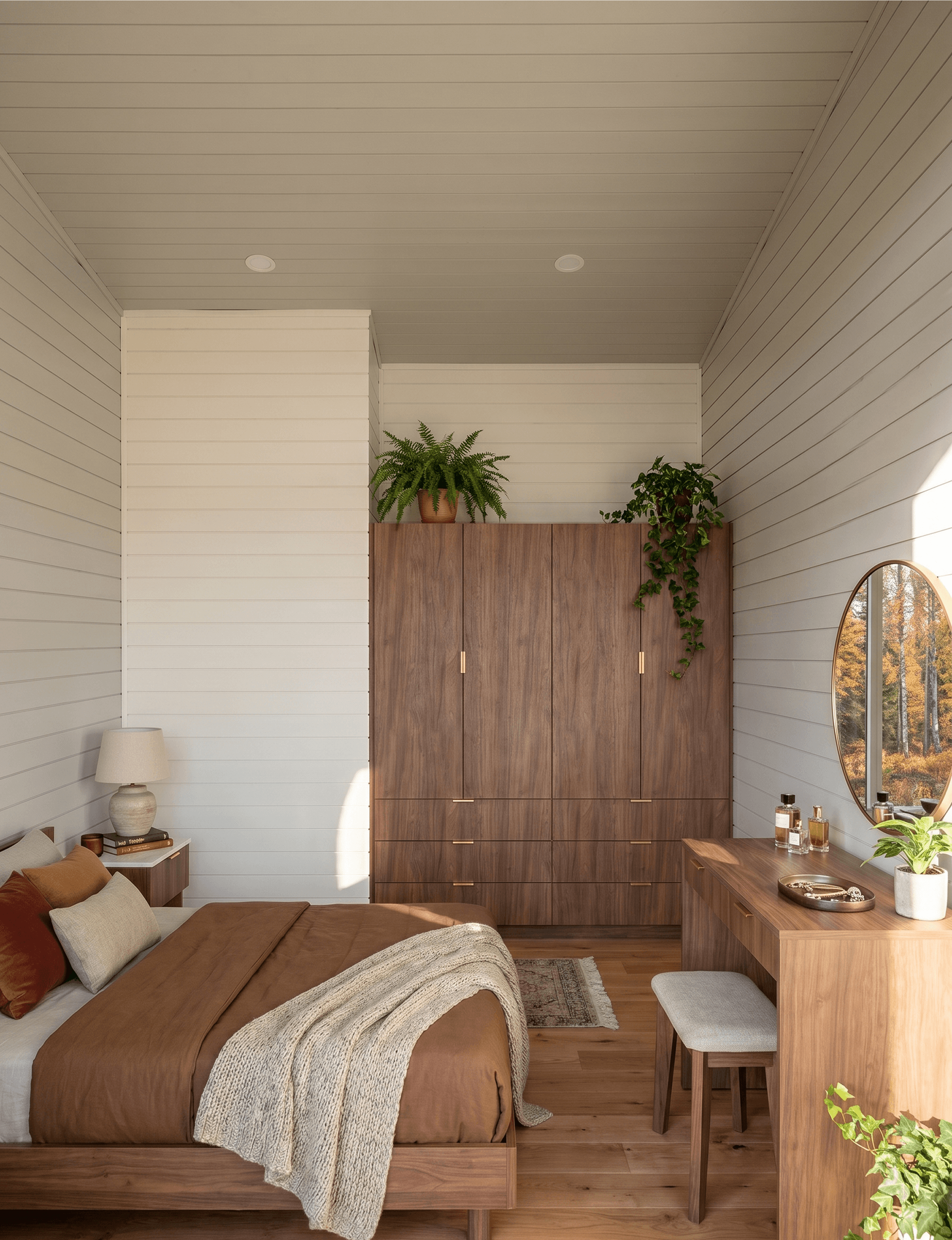
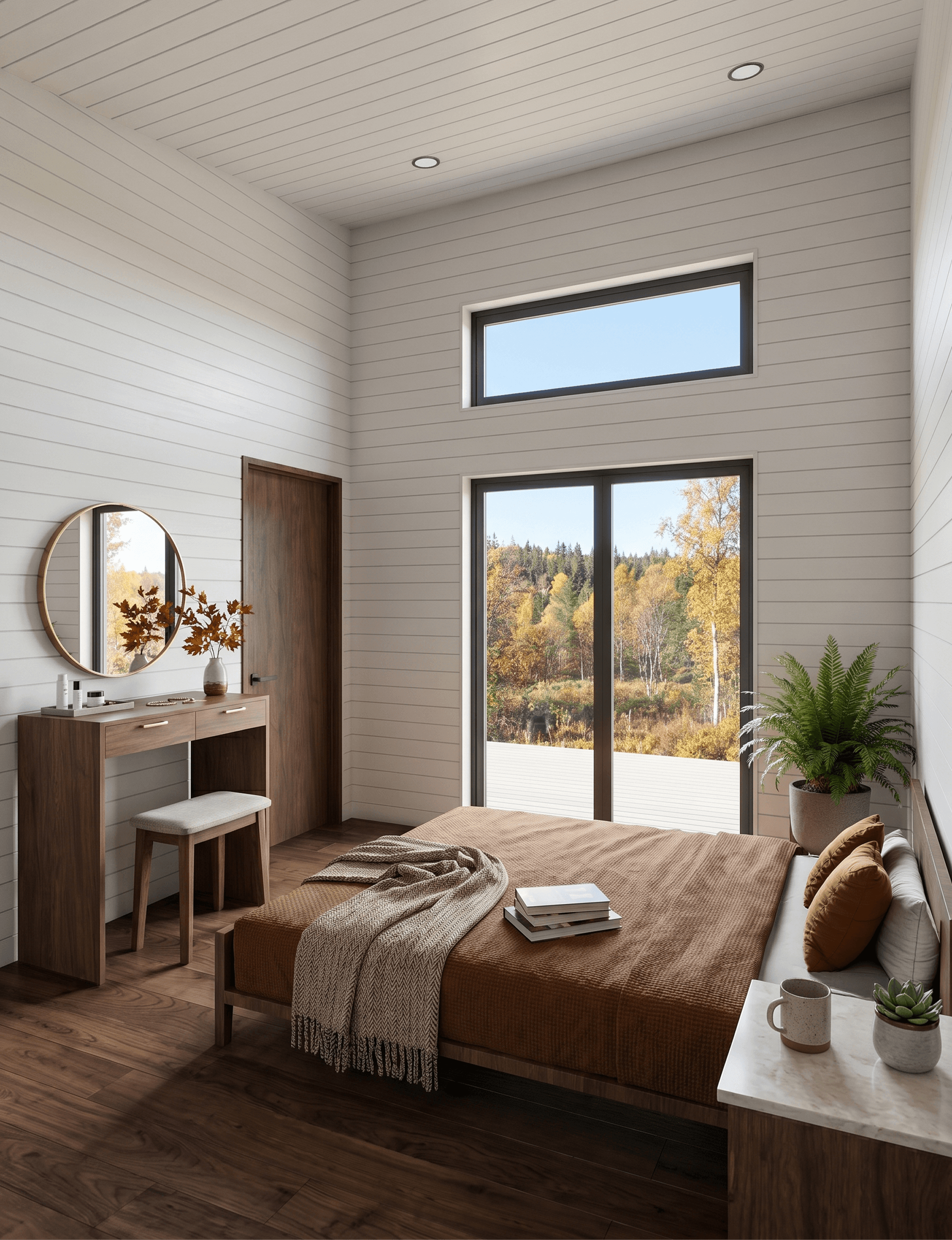
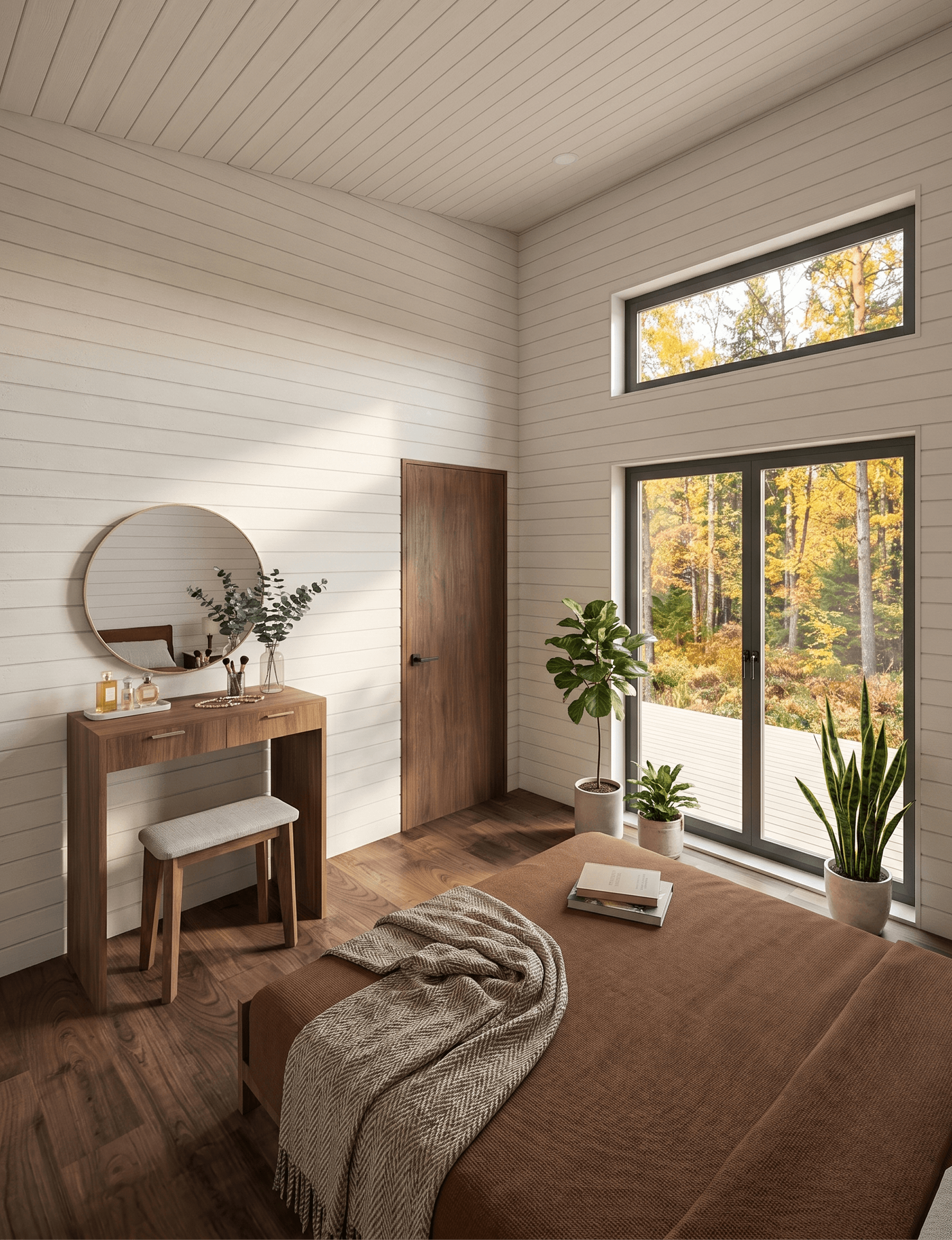
A walnut dressing vanity sits against one wall, with a round mirror and brass hardware that picks up the same detail language used in the bathroom and kitchen. The bed's positioned to take in the forest view, which makes the glazing feel like an intentional design decision rather than just a window placed for compliance.
What makes the master bedroom work well:
Full-height sliding glass doors to the forest, a large, uninterrupted connection to the landscape outside.
Clerestory strip window above for secondary natural light
Walnut dressing vanity with a round mirror and brass fittings, a considered piece of built furniture rather than a generic bedroom fixture
Cream shiplap walls and ceilings consistent with the rest of the cabin.
Dark hardwood floors with a warm tone throughout.
The room doesn't feel like it's trying to be impressive. It feels like a room you'd actually want to sleep in.
The Guest Bedroom
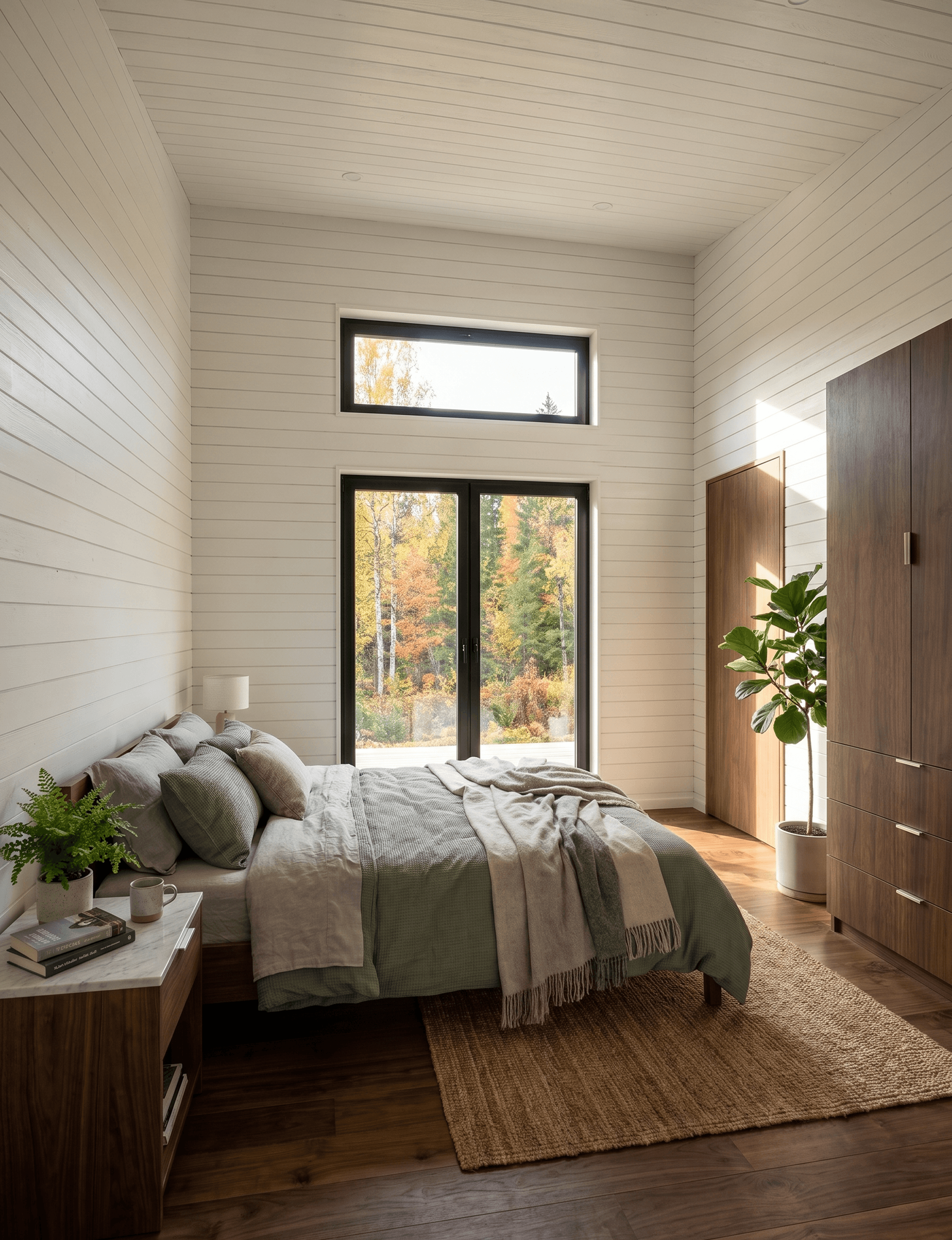
The guest bedroom is the most privately connected room in the design. Full-height sliding glass doors open directly onto the deck, which gives guests their own outdoor access point, independent from the main front entry and the shared living zone. That detail adds a level of separation that makes the room work better for guests on extended stays or for short-stay rental setups where privacy is a consideration.
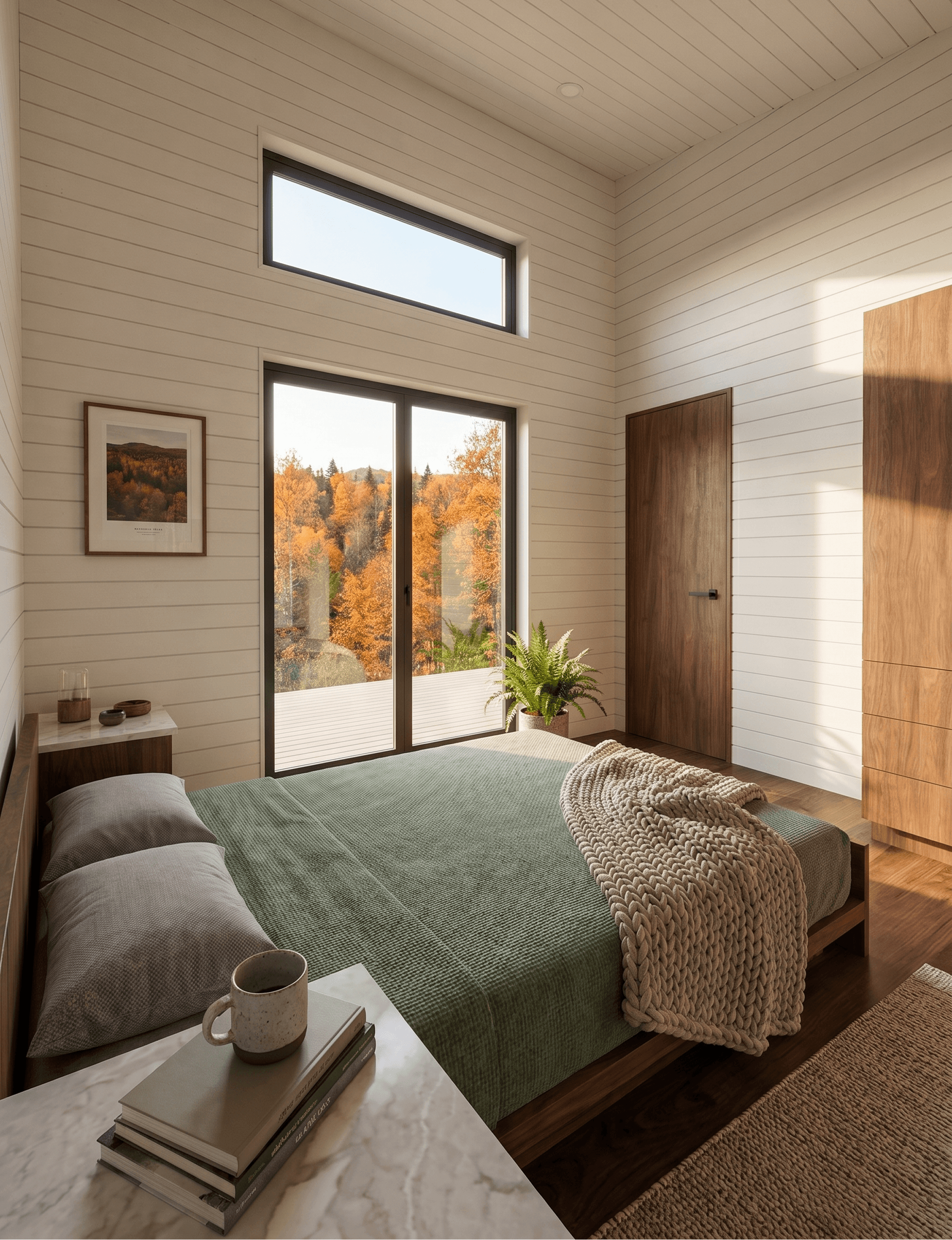
The room has the same cream shiplap walls and ceiling, the same dark hardwood floor, and the same black-framed window format as the rest of the home. A large walnut wardrobe unit on one wall provides proper storage for extended stays. The bed's dressed in green and sage linen with textured pillows, and a natural jute rug under the bed adds a layer of warmth to the floor without fighting with the timber beneath. A walnut bedside table sits to one side, with a small plant and a lamp, simple but complete.
The guest bedroom functions as a full bedroom, not as a secondary or lesser version of the master. It has comparable natural light, a direct outdoor connection, and enough storage for real use. For a 3 bedroom cabin plan, that kind of quality across all rooms is what separates a livable design from one that just counts rooms.
The Study Room
The third bedroom's set up as a single room with a built-in study space along one wall. A walnut desk runs the length of the left-hand wall, with two side-by-side windows above it that look out into the surrounding forest. The windows are casement-style rather than sliding glass doors, a narrower, more private format that suits a work-focused room.
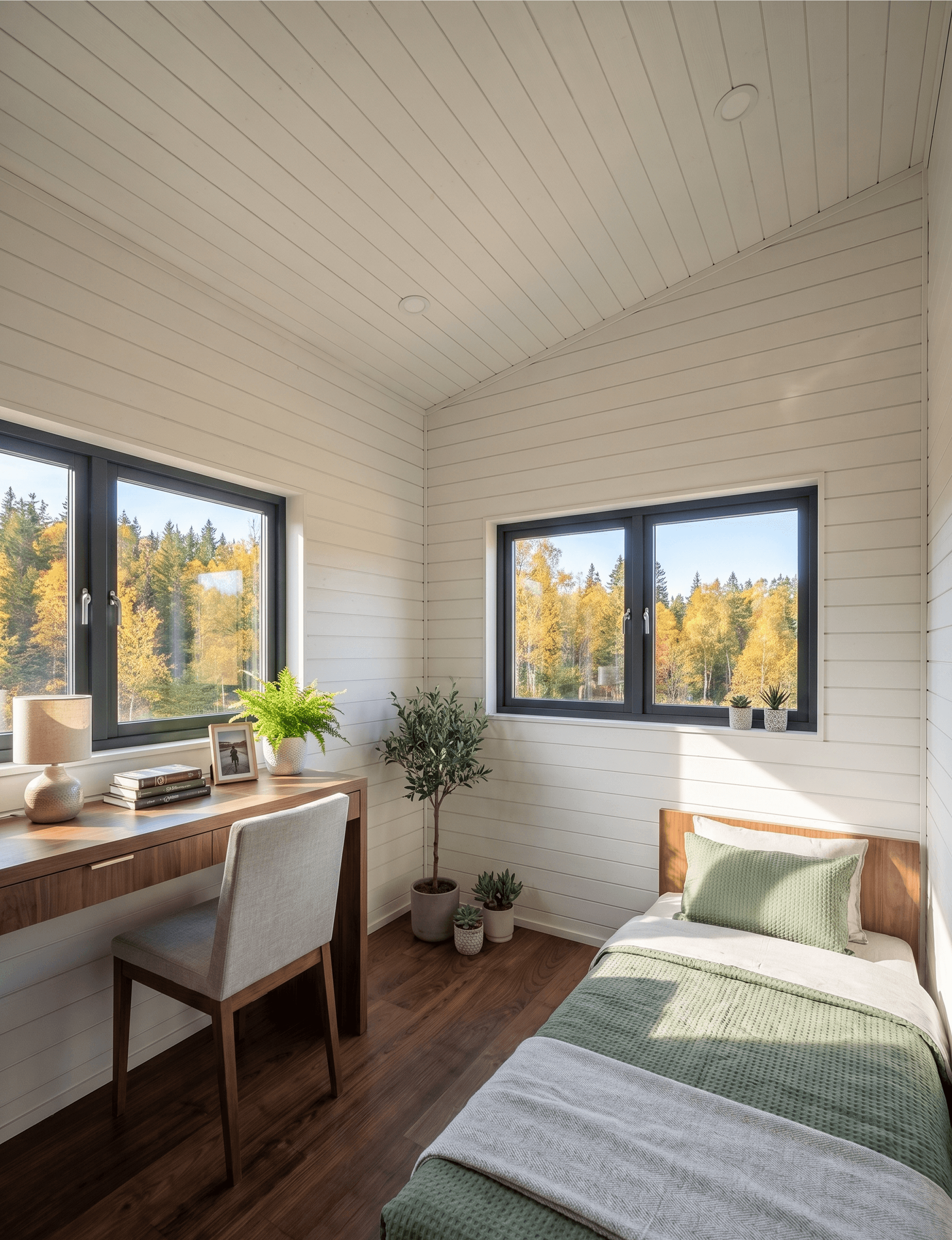
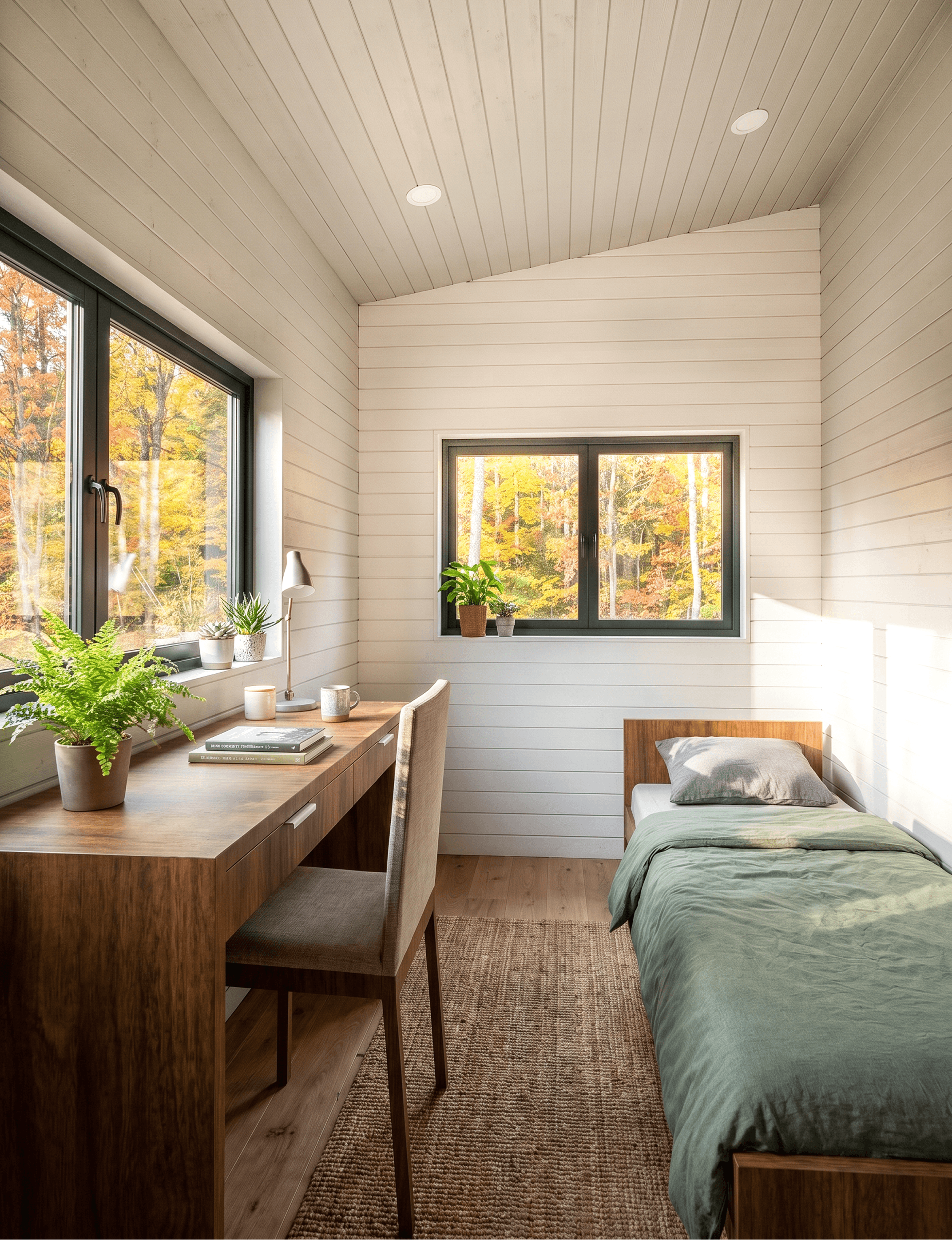
A single bed with sage green bedding sits against the opposite wall, and a small plant sits on the windowsill and on the desk. It's a compact room that serves multiple purposes without feeling as though it's trying to be something it isn't. For a family, it works as a children's room or a quiet retreat for a teenager. For remote workers or couples on extended stays, the built-in desk makes it a functional home office alongside the sleeping space.
The study room's a practical inclusion in a 3 bedroom cabin plan. Not every cabin design handles the third bedroom well, it often becomes a storage room or a cramped afterthought. Here, it's a defined, usable space with clear purpose.
The Chestnut Hideaway in Summary
The Chestnut Hideaway is a 900 sq ft cabin plan that puts social livability first. It has a three-bedroom layout that works for families and groups, an open-plan core sized for real gatherings, and a material palette, dark cedar outside, walnut and cream shiplap inside, that gives it a warmth and character that's hard to achieve at this scale. The wood stove, the six-seat dining table, the guest room with its own deck access, and the integrated laundry in the bathroom are all decisions that make the home more livable rather than just more impressive on paper.
For builders looking at the 900 sq ft cabin market, the Chestnut Hideaway is a design that demonstrates what this footprint can actually do when the layout and material quality are taken seriously. If you're a builder working in the cabin segment, you can learn more about how Tiny Easy supports cabin builders through every stage from design to client presentation. And if you're interested in adding a design like the Chestnut Hideaway to your model range, book a demo with the Tiny Easy team to see how you can design, visualise, and present 3 bedroom cabin plans like this to your clients.
How We Designed this Cabin Concept
Every part of this cabin plan concept, from the exterior details to the interior layout, was designed entirely within the Tiny Easy platform. No third-party tools, no hand-drawn floor plans, no outsourced renderings. From the first concept through to final handoff documents, the whole process lived in one place.
Design Creation
For builders, one of the biggest bottlenecks in turning interest into a real sales conversation is the time it takes to get a clear design in front of a client. Traditional 3D design tools can be slow to learn, and relying on a designer or draftsperson for every early concept can add cost and delay before the client has even had a chance to properly understand the home.
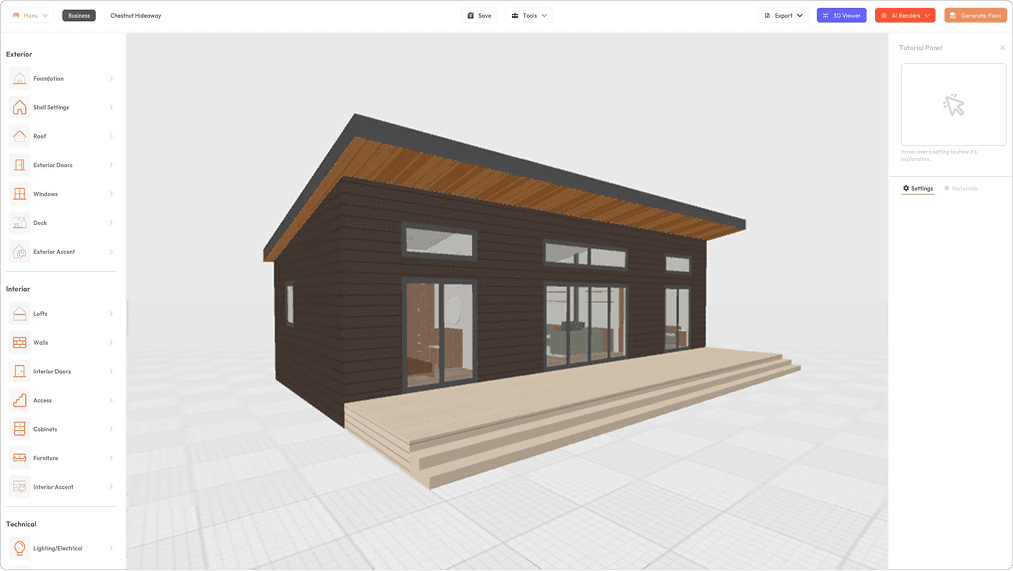
The 3D Designer is Tiny Easy’s design workspace for creating, managing, and tailoring tiny homes, cabins, granny flats, ADUs, and more within one connected system. Builders can use it to build out their core model range, save designs as reusable templates, test new ideas, explore layout options, and refine their designs over time.
Inside the Designer, the structure can be shaped using tools like Foundation, Shell, and Roof, before completing the model with doors, windows, walls, interior doors, cabinetry, furniture, fixtures, lighting, and finishes. This gives builders a practical way to create complete 3D concepts without needing to start from scratch or rely on complex modelling workflows.
Where this becomes especially valuable is in the sales process. Instead of designing a new cabin from a blank canvas for every enquiry, builders can pull the most relevant model from their existing range into a client project, tailor the layout, finishes, openings, and key details, then present a concept that feels specific to that client.
That speed changes the quality of the conversation. Clients are not left trying to imagine the home from 2D plans, rough sketches, or verbal explanations. They can see the design clearly, understand the layout, explore the options, and build confidence in the direction before moving further into pricing, proposal, or approval.
For builders, the result is a faster and more professional path from enquiry to client-ready cabin concept. The 3D Designer helps turn design into a sales tool, giving builders a repeatable way to respond quickly, communicate clearly, and move serious clients forward while interest is still warm.
Visualization
Once a design is complete, the next challenge is presenting it in a way that actually converts interest into commitment. Traditionally, that meant outsourcing renders to a freelancer — which adds cost, turnaround time, and rounds of back-and-forth — or investing in professional rendering software that requires its own lengthy setup before a single image is produced. For a small home builder running a lean operation, neither is a sustainable way to work.
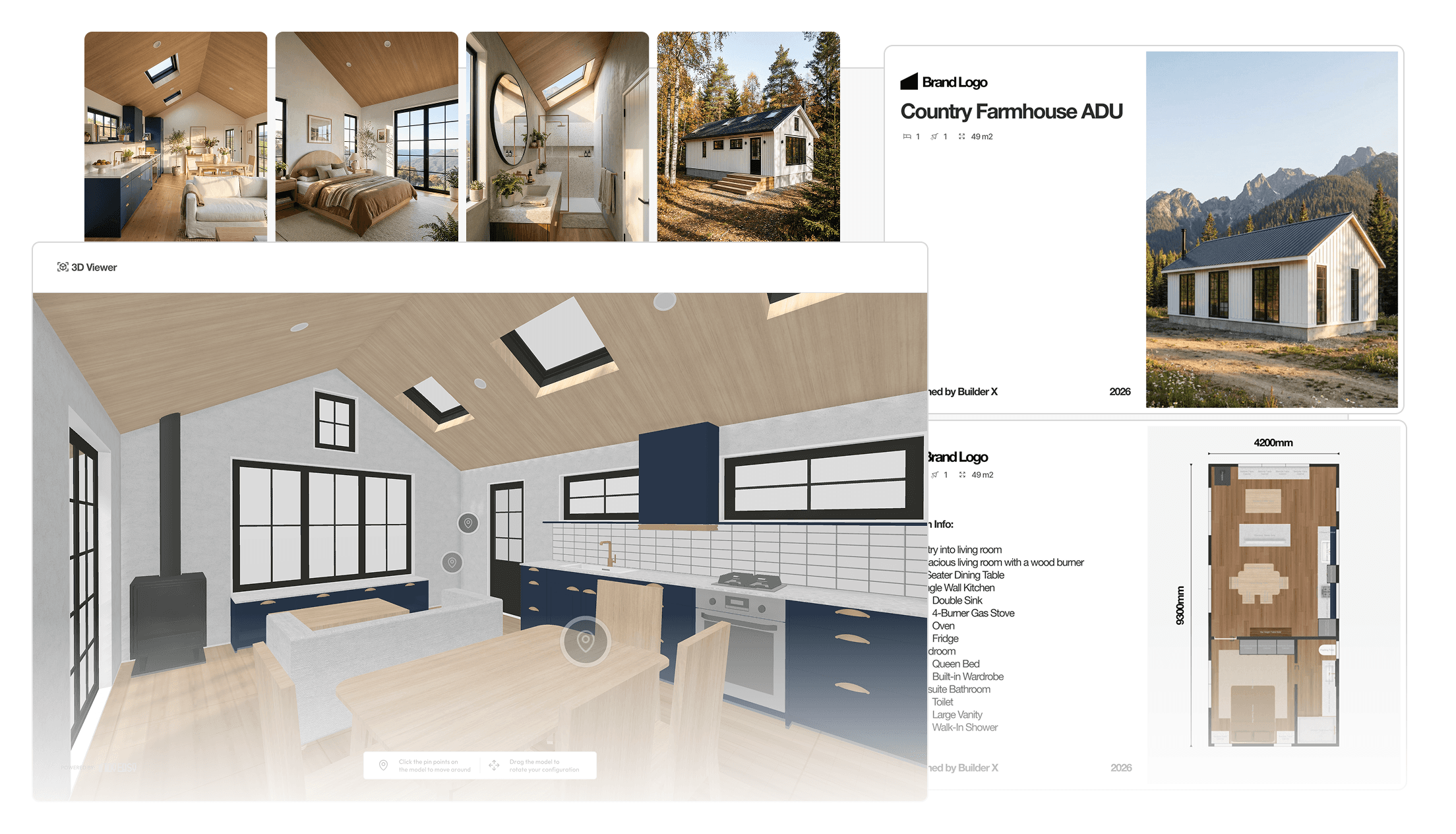
The AI Render Tool takes care of that. Once the design is finalised in the 3D Designer, renders are generated directly from within it. The only setup required is positioning the camera, choosing an environment, setting the time of day and season, and hitting render. The result is a photorealistic image of the home, produced in minutes rather than days — and at a fraction of the cost of conventional methods.
The 3D Viewer Tool adds another layer to the client experience, letting them explore the completed design in interactive 3D from any device. Sharing it is as simple as sending a link. Scale and spatial flow can be difficult to communicate on paper — paired with AI Renders, a 3D virtual tour gives clients the confidence to take the next step without hesitation.
Presentation
Once a design is ready, the next challenge is turning all the project information into a proposal that feels clear, professional, and easy for the client to understand. For many builders, this is one of the most tedious parts of the sales process. The design may already be done, the renders may be ready, and the pricing may be prepared, but pulling everything together into a polished client proposal often means jumping between Canva, PowerPoint, PDF exports, spreadsheets, and old proposal templates that are either too rigid or too difficult to edit.
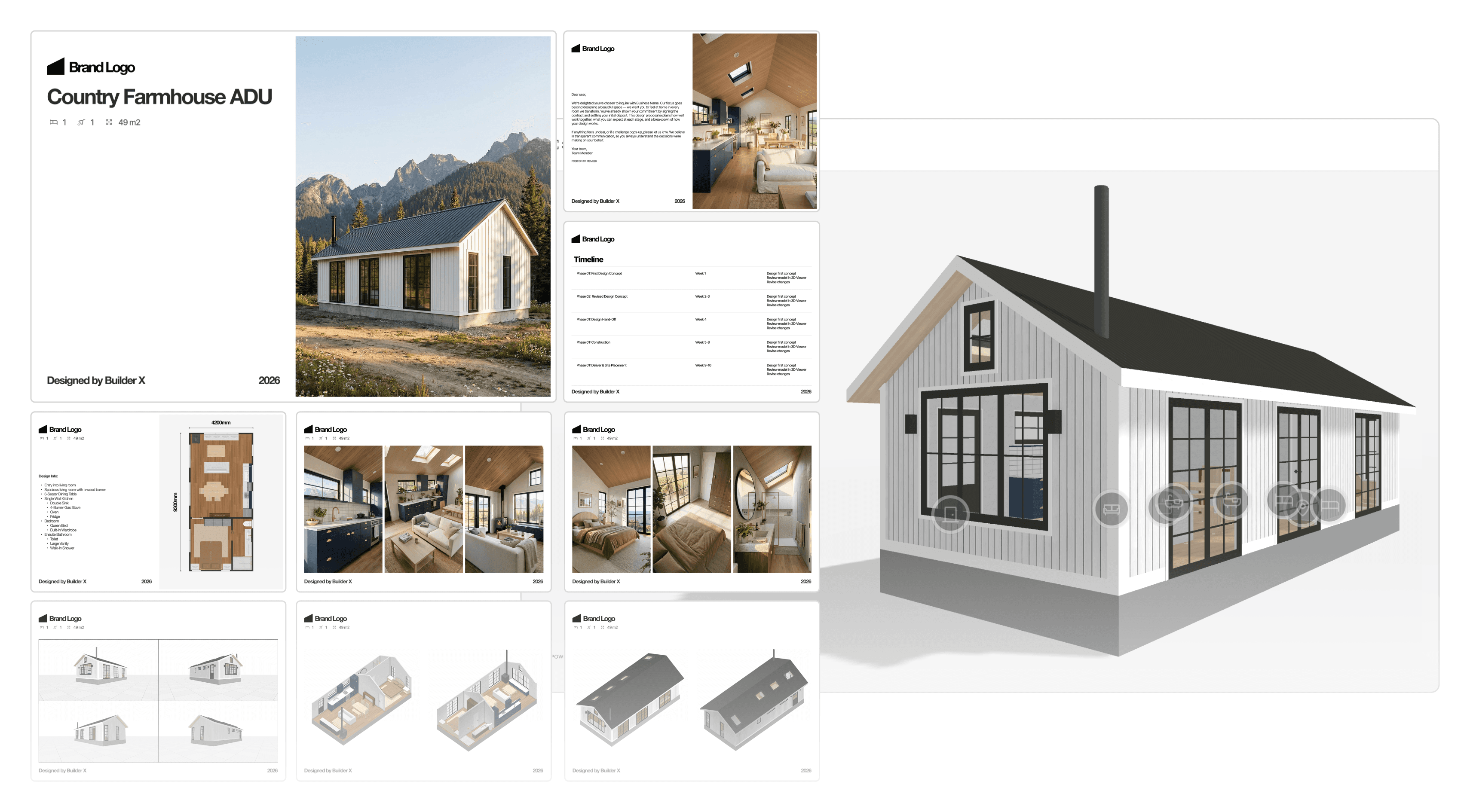
The Proposal Builder is Tiny Easy’s proposal creation tool for building professional, branded client proposals within one platform. It helps builders bring together the key parts of a project, including 3D Viewers, PDF plans, AI Renders, specifications, pricing, inclusions, available options, and next steps, into one clear presentation.
Instead of starting from a blank document every time, builders can begin with suggested proposal templates designed around the way small home projects are actually sold. These templates provide a practical page structure for presenting a customised design, with sections for introducing the project, showcasing the design, explaining the layout, outlining specifications, presenting pricing, and guiding the client toward the next step.
This gives builders a faster way to insert the right content in the right order without needing to design a full proposal from scratch. Pages can be adjusted, removed, duplicated, or added as needed, so the proposal can still be tailored to the client without becoming a complicated custom design task.
The value is not just that the proposal looks better. It helps the client understand the project faster. Instead of receiving disconnected files, flat plans, separate renders, and a pricing document, they get one polished proposal that brings the design story together. They can see the home, understand the layout, review the key details, and know exactly what happens next.
For builders, this creates a more repeatable and professional sales workflow. It reduces the time spent assembling proposals manually, keeps presentations more consistent across the team, and helps move clients toward sign-off, approval, or deposit with greater confidence.
Handoff
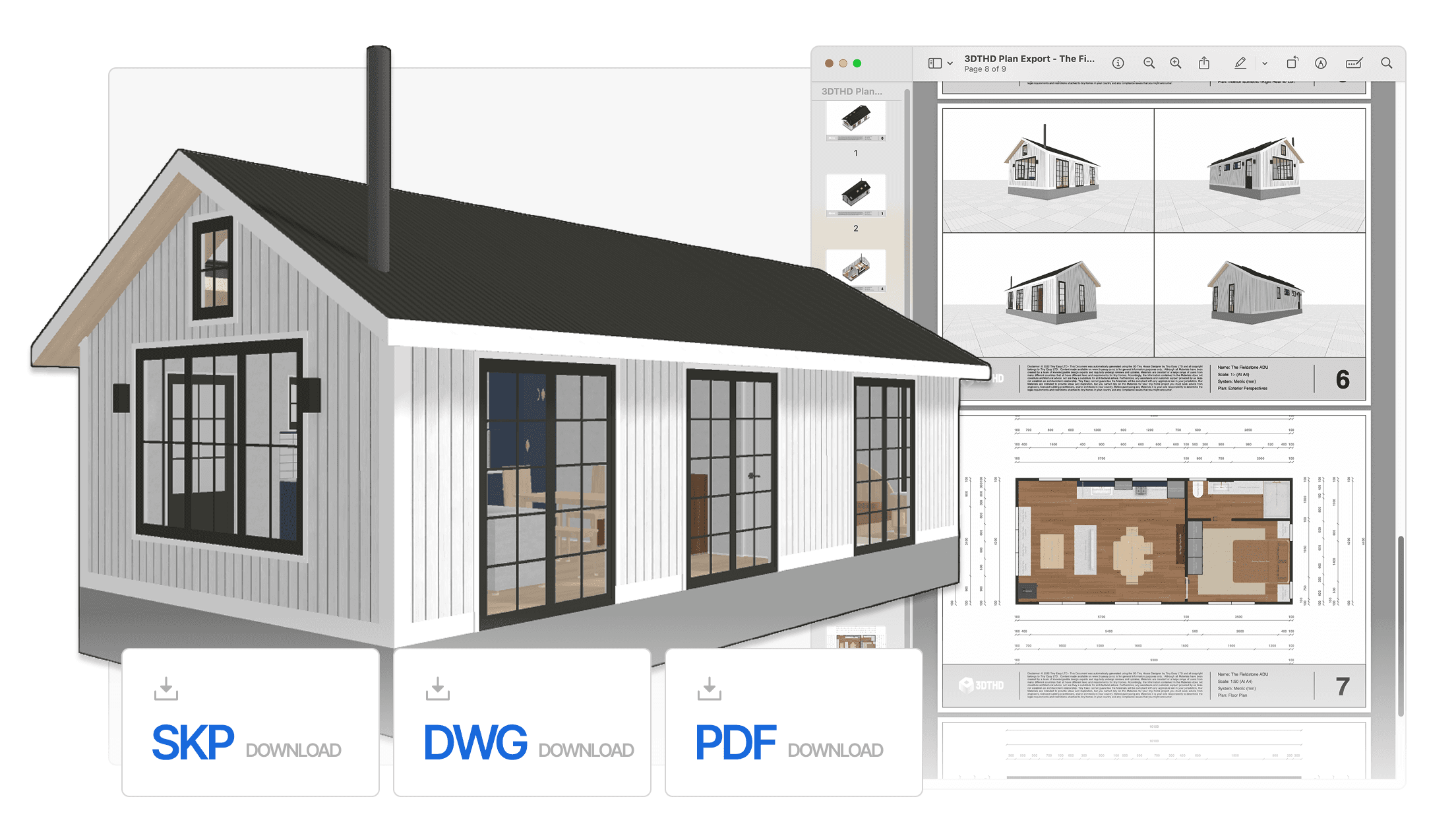
When the design is approved and it's time to move into documentation, the 3D Designer exports everything needed to take the project forward. PDF plans are generated directly from the model — accurate, professional documents that give a draftsperson or architect a clear picture of the design intent without any redrawing required.
Alongside the plans, an auto-populated material take-off spreadsheet exports directly from the design. Rather than manually costing a new model from scratch, the material list is already populated and ready to work from — saving hours in the estimation process and reducing the margin for error when putting a quote together.
For those who need to take the model further, the 3D Designer also exports a SketchUp file, allowing the design to be carried into more advanced workflows without having to rebuild from scratch.
For builders, this closes the loop on the entire process — from first sketch to professional handoff — without the design ever leaving the platform. It's a faster, cleaner way to work that reduces errors, saves cost, and keeps the project moving.
Ready to Design your Own?
This cabin design is proof that a small footprint doesn't mean compromising on quality — in the design, the experience, or the process behind it.
What made it possible wasn't a team of designers or an expensive production pipeline. It was a single platform, built specifically for the way small home builders actually work.
If you're a builder who wants to walk into your next client meeting with renders like these, proposals that are ready to go, and a process that runs end to end without the usual friction — book a call with us and let's talk about what you're building.


100+ Businesses use Tiny Easy in their Sales, Design & Proposal Workflow