Product
Learn how to create a visual building construction proposal that helps clients say yes. Get expert tips, project examples, and templates to close more deals.
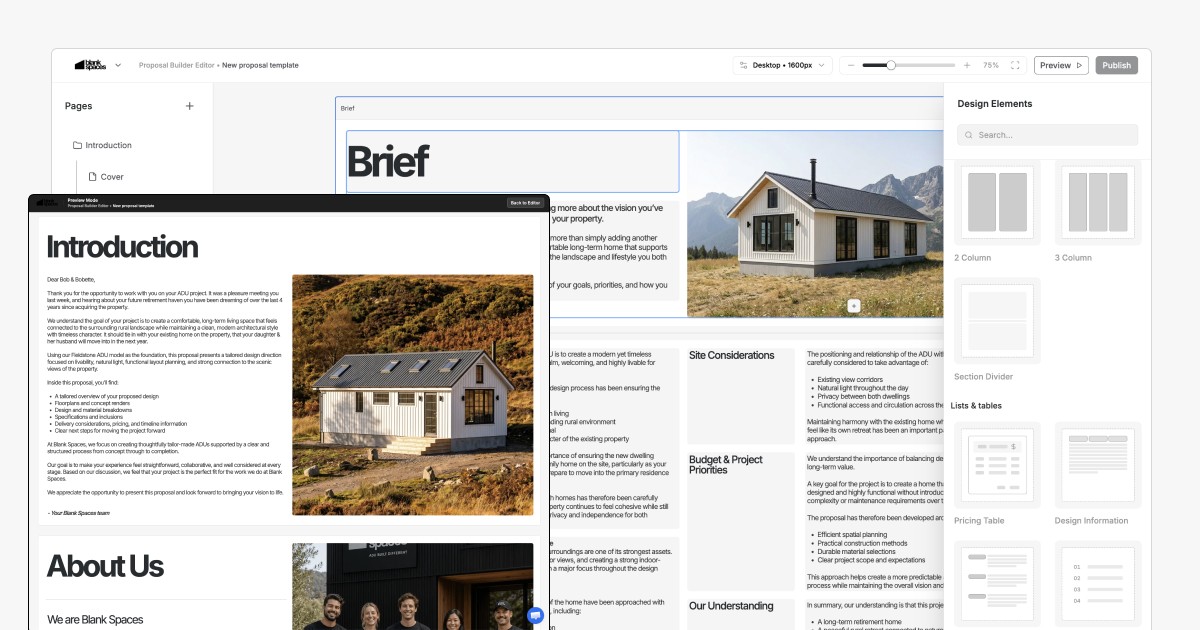
For many small home builders, the proposal stage is where things slow down. Designs are scattered across email threads, pricing lives in a spreadsheet, and pulling it all together into something client-ready takes more time than it should. When builders search for “software building construction,” what they’re often really looking for is a tool that helps them manage the design, proposal, pricing, and client presentation process in one place.
However, the proposal they receive is a basic PDF, a rough quote, or a wall of line items with no visuals to support it. That's often enough to introduce doubt, slow the decision, and hand momentum to a competitor who presented their work more clearly.
The good news is that this is a solvable problem. Purpose-built software for building construction has made it genuinely practical for small home builders to put together stronger building proposals that include 3D visuals, floor plans, AI renders, indicative pricing, upgrade options, and clear next steps, without spending hours stitching it together from disconnected tools.
This guide walks through exactly how to build a visual building construction proposal that gives clients the clarity and confidence they need to say yes. From structure and content to visual communication and common mistakes to avoid, you'll find a practical framework that fits the way small home builders actually work.
The High Cost of a "Basic" Construction Proposal
A building construction proposal is more than a quote attached to an email. Done well, it's the document that walks a prospective client through the full picture: the design, scope, inclusions, pricing context, timeline, and what happens next. For many buyers, it's the first time everything comes together in one place. For builders, it's one of the most important steps in the entire sales workflow.
Yet for a lot of small home builders, the standard approach is still a basic PDF, a spreadsheet, or a rough email quote. If you've ever searched for a building construction project proposal sample to figure out what a stronger version should look like, you're not alone. The gap between what most builders send and what actually moves buyers forward is wider than it should be.
The proposal stage alone accounts for an average of 42 days within the 134-day construction sales cycle. That's a significant window where buyer confidence can either build or erode. The National Association of Home Builders puts it plainly: "The speed of the proposal is often equated with the speed and reliability of the builder. A delay in the quote is seen as a preview of project delays." When a buyer waits two weeks for a quote that arrives with no visuals and a wall of line items, it's not just frustrating. It signals risk.
There's also a visualization gap that text-based proposals simply can't bridge. According to Dodge Construction Network, 82% of construction firms report that helping clients visualize the final product is the biggest challenge during the sales process. A floor plan in 2D doesn't excite. It requires interpretation. And buyers who can't picture the home clearly tend to stall, compare, or go quiet.
The builders who consistently win, with top performers closing proposals at 40–50%, nearly double the industry average, share two common strengths: professionalism and speed. They use purpose-built software for building construction that connects visuals, scope, pricing, and next steps into one clear client experience, rather than stitching it together from disconnected tools.
That's exactly what the right proposal workflow makes possible. And the sections that follow break down exactly how to build one.
What Should a Building Construction Proposal Include? The 8 Core Sections
If the previous section made one thing clear, it's that a weak proposal costs you more than just a single job. So what does a strong one actually look like? Whether you're working from a building project proposal example for a tiny home, an ADU, or a prefab cabin, or building your own template from scratch, the structure matters as much as the content inside it.
A well-built proposal isn't a price sheet with a cover page bolted on. It's a guided document that takes the client from "I'm interested" to "I'm ready to move forward." Think of it less like a quote and more like a walkthrough, one that answers the questions a buyer has before they even think to ask them. Here's how to structure it.
1. Introduction
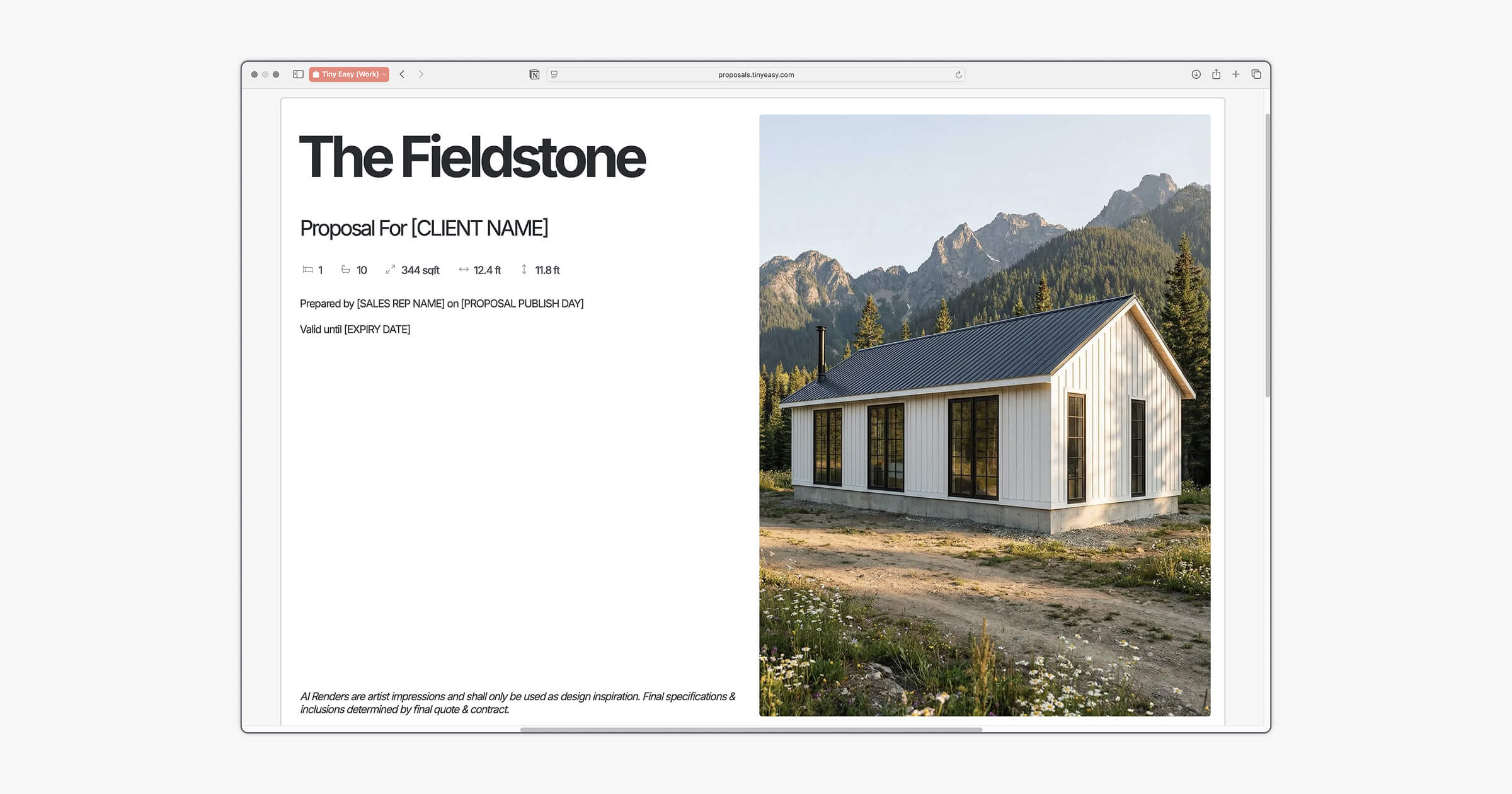
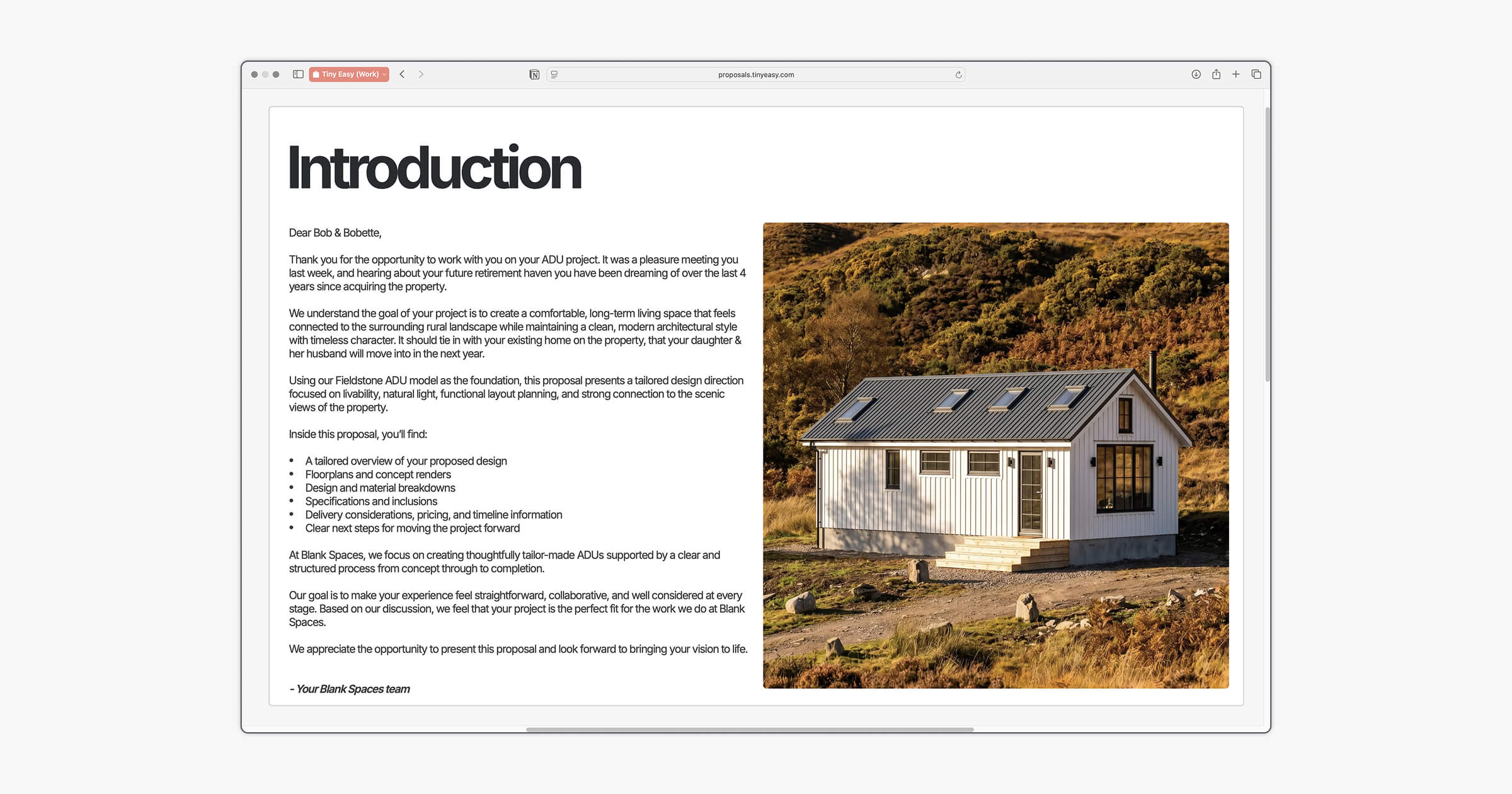
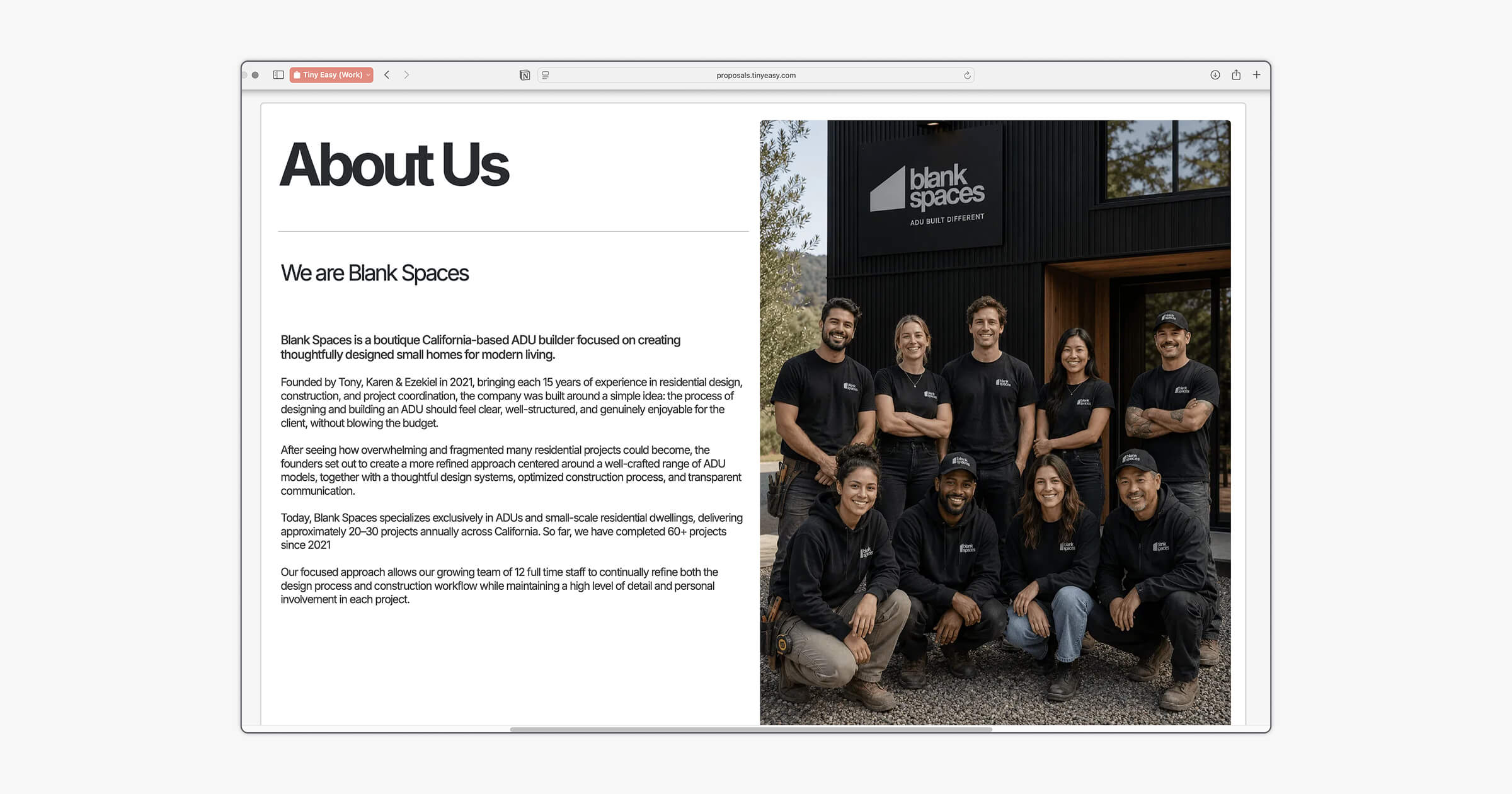
Start with a professional cover page, a table of contents, a short introduction, and an About Us section. This sets the tone immediately and signals that the building proposals you send reflect the same care and professionalism clients can expect from your build process. Clients want to know who they're dealing with before they read a single spec, and a well-structured opening gives them exactly that.
2. Project Overview
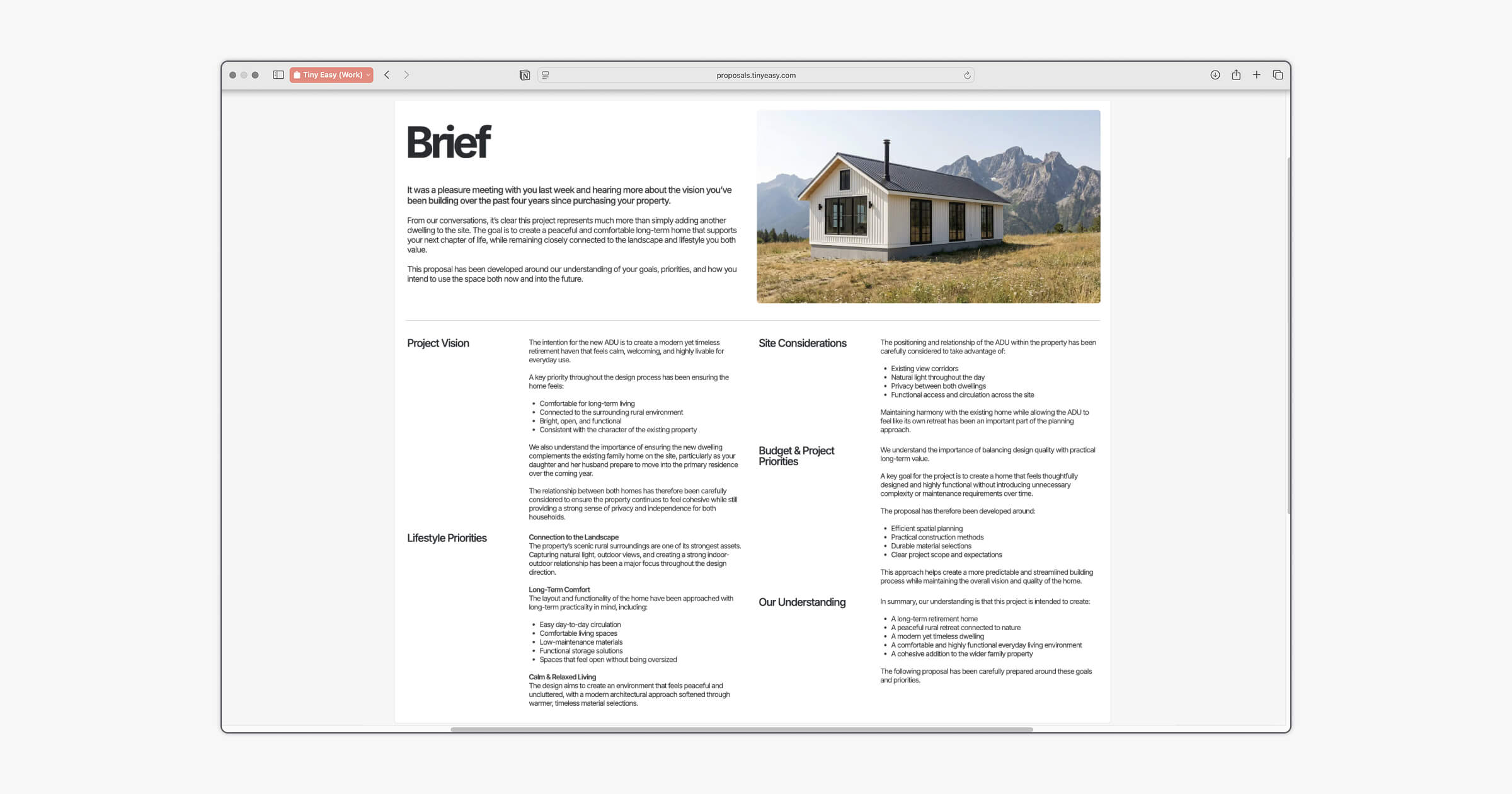
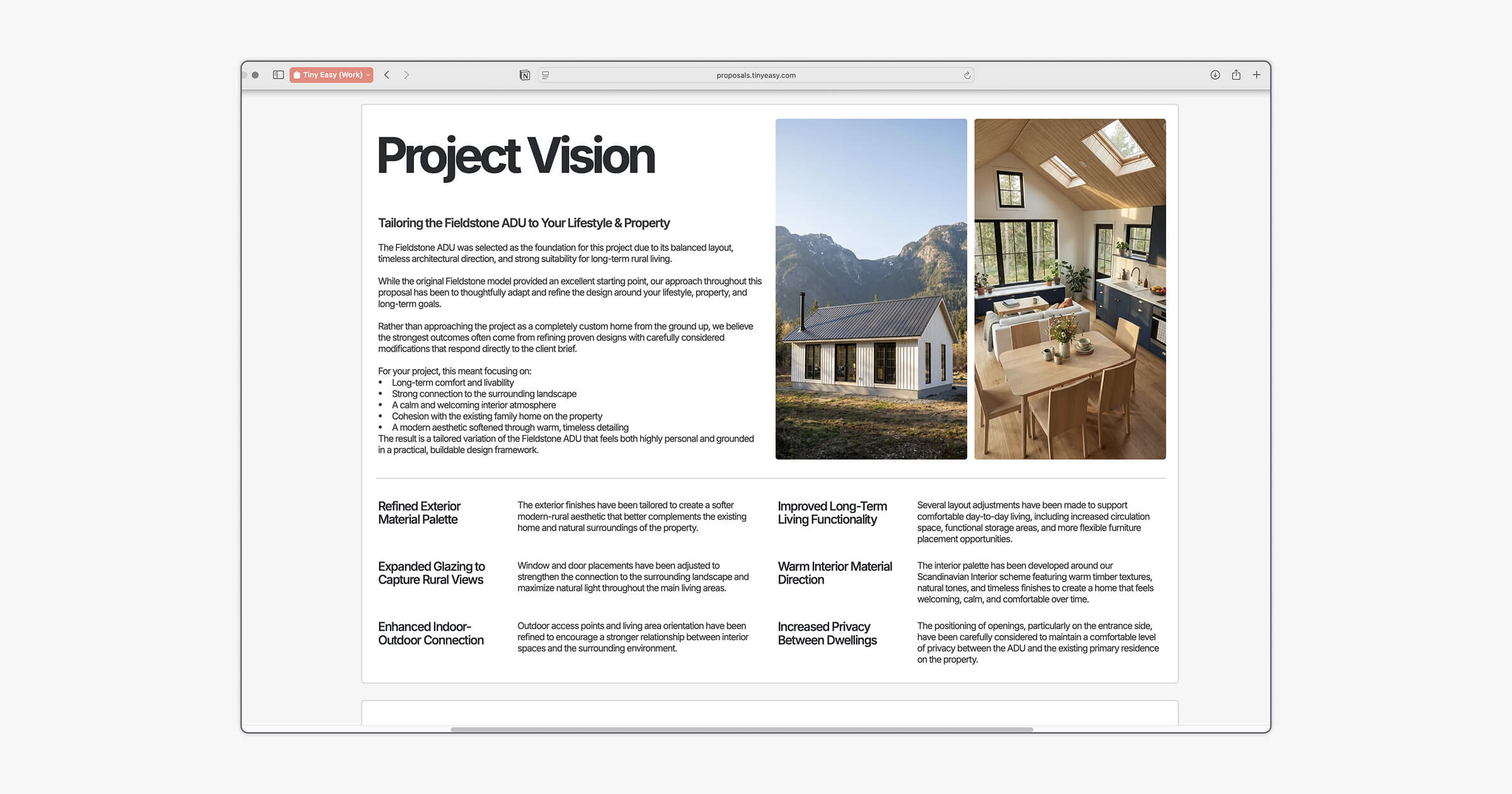
When thinking about how to write a building construction proposal that actually moves buyers forward, this section is where you set the foundation. Summarize the client brief and the project vision clearly: what did they ask for, what site or situation are they working with, and what are you proposing to deliver? Even a few well-written paragraphs that reflect back what the client shared goes a long way. It shows you listened, understood their goals, and have tailored your response to their specific situation rather than sending a generic document. That kind of attention builds trust early, and trust is what carries a buyer through the rest of the proposal.
3. Your Home
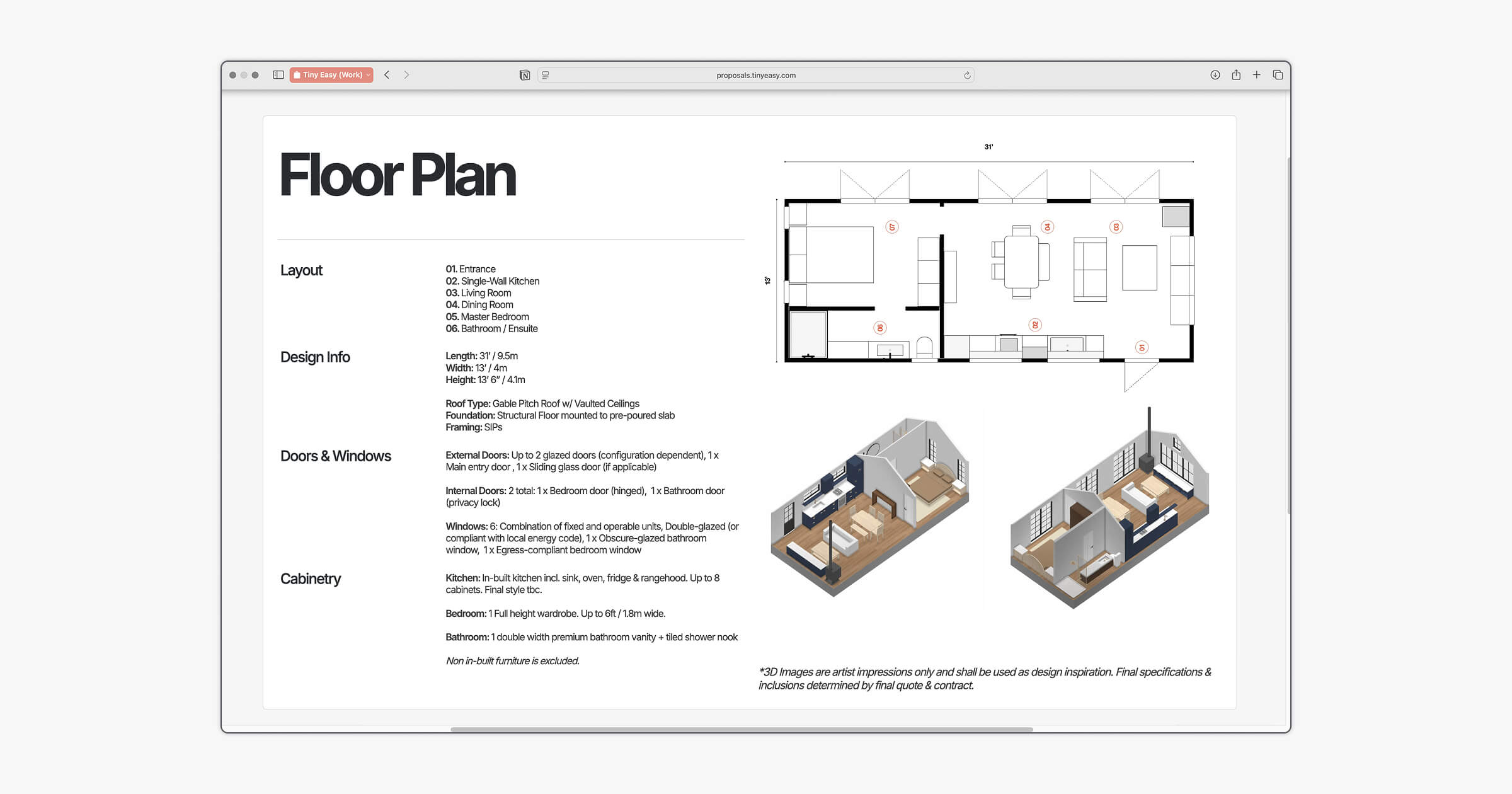
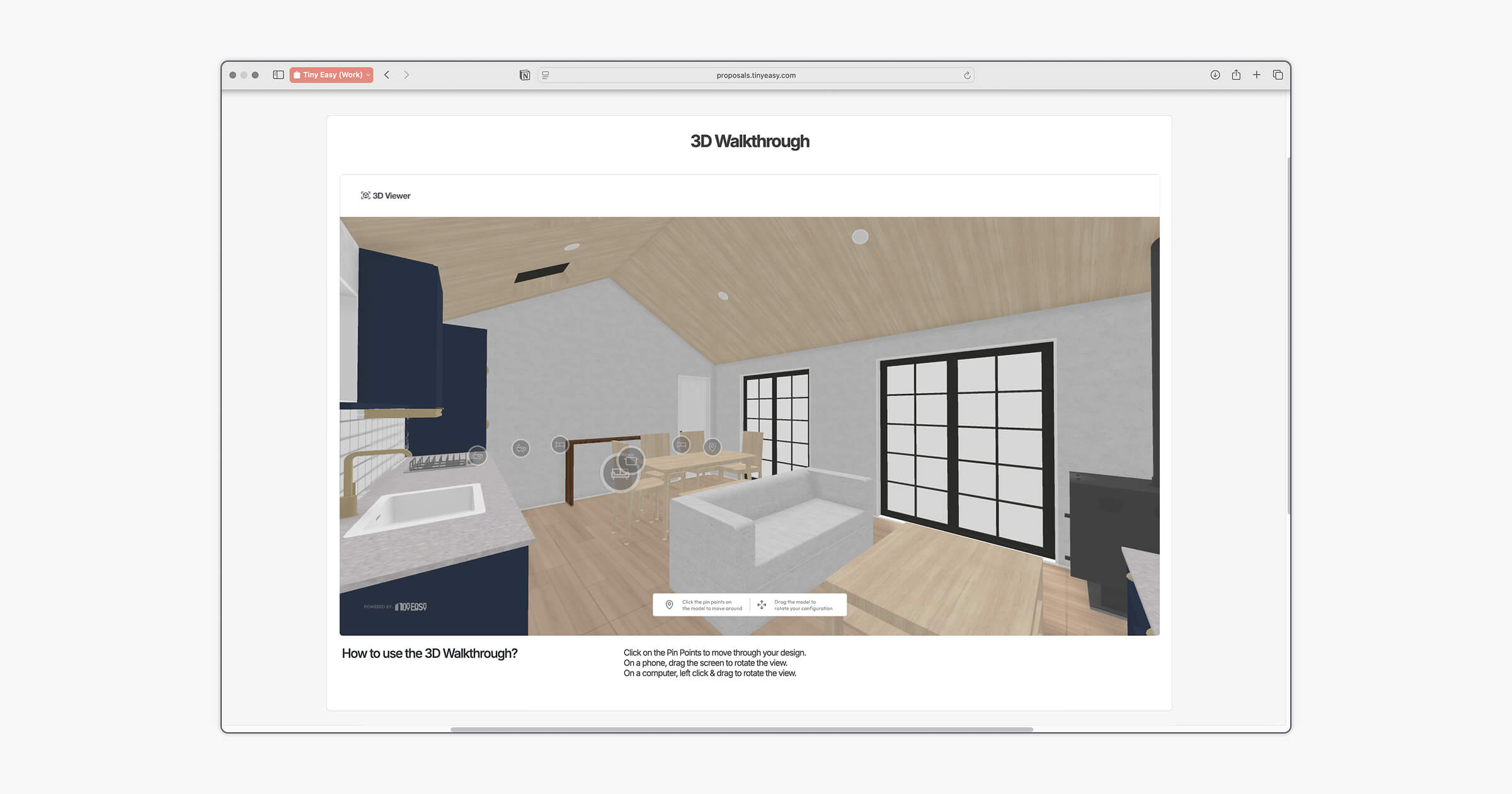
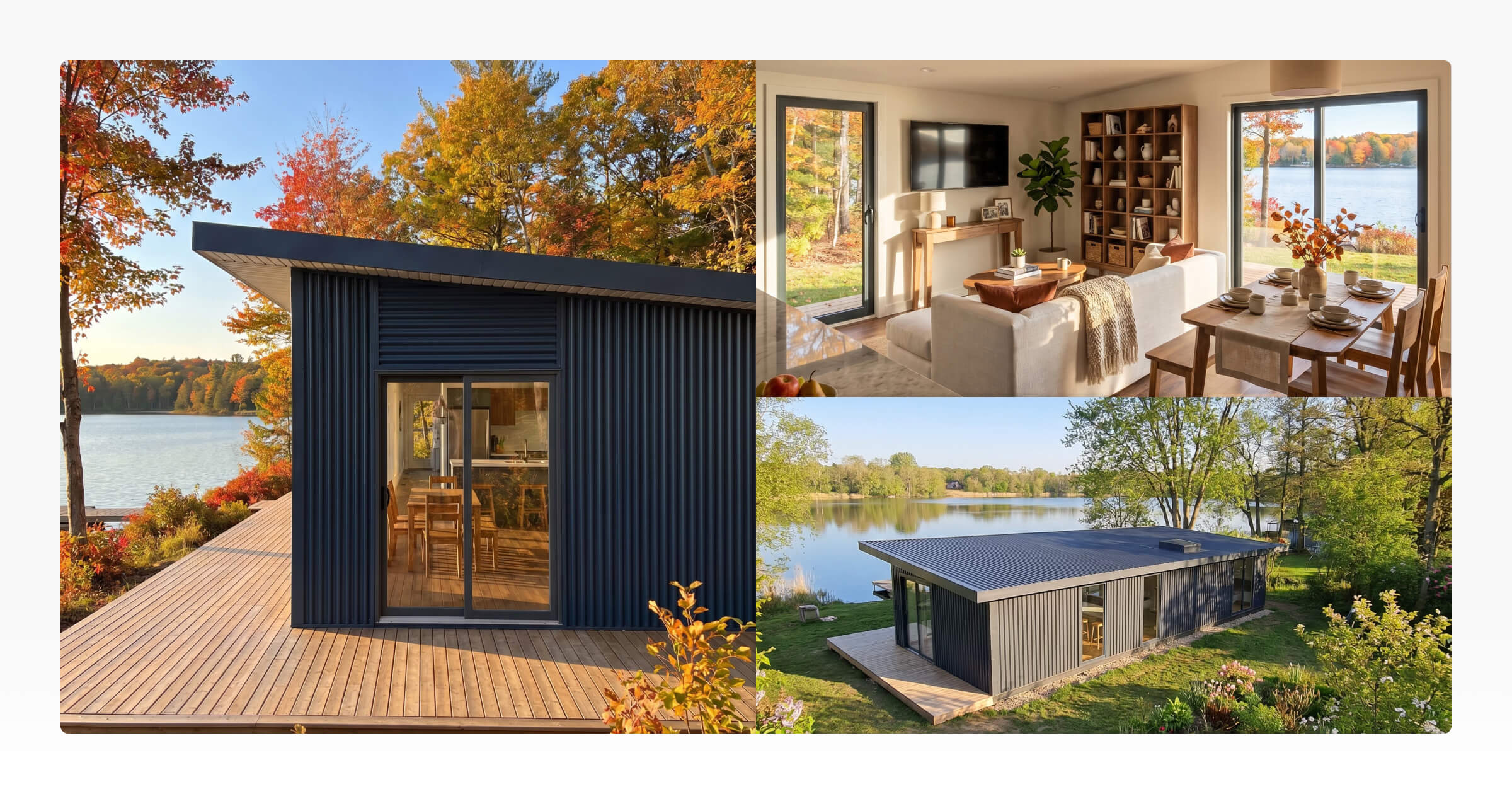
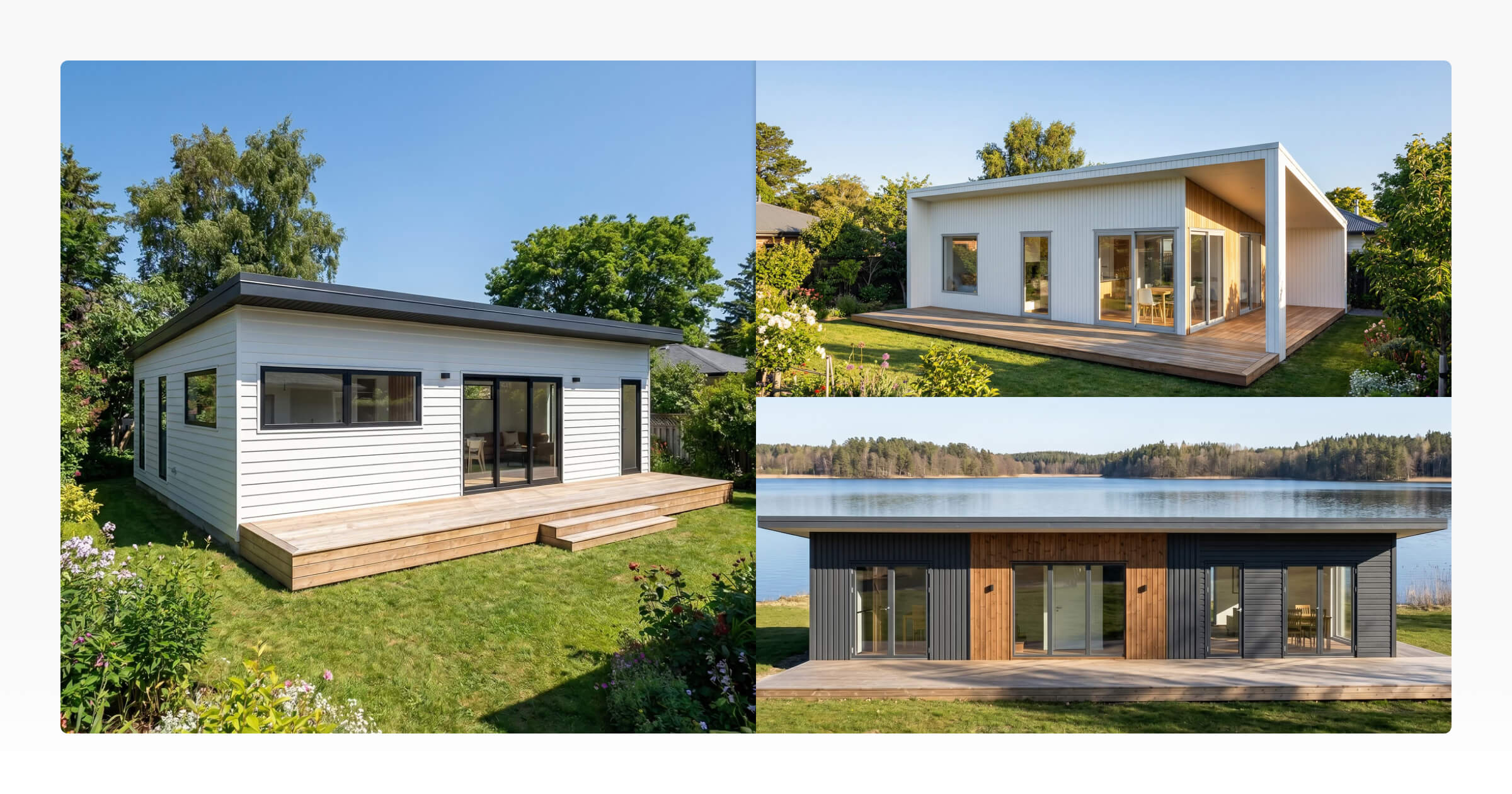
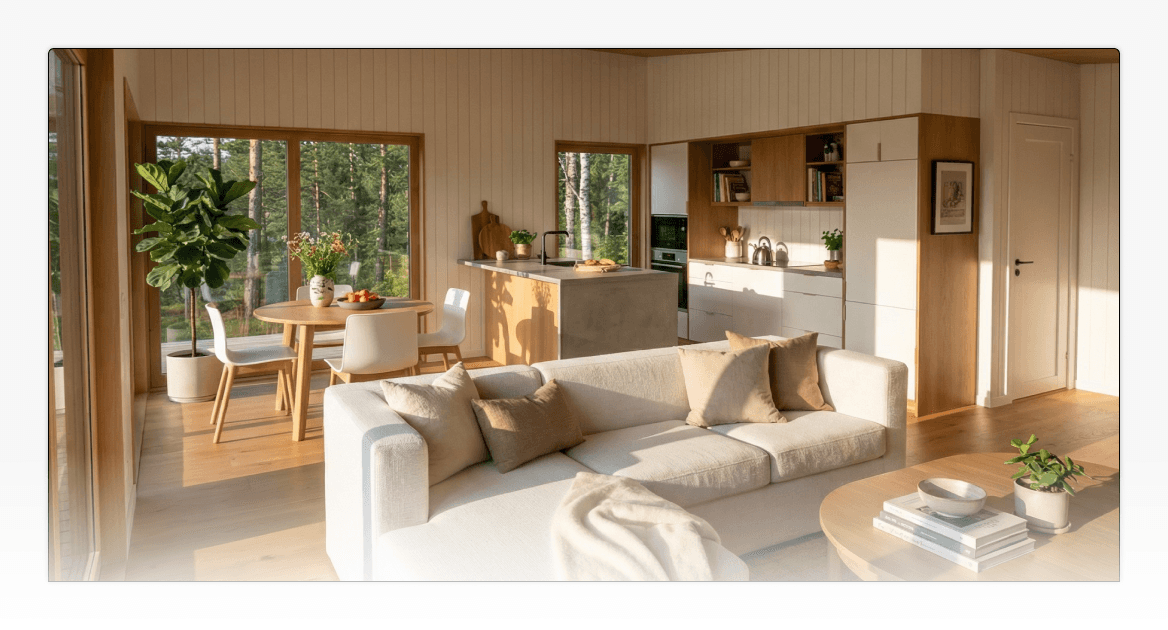
This is where the proposal needs to do real visual work. Floor plans, exterior renders, 3D walkthroughs, room visuals, and design previews all belong here. As research from Procore and Construction Business Owner Magazine indicates, proposals that include 3D visualizations achieve a 23% higher win rate than those relying on 2D blueprints alone. And it makes sense. Clients don't buy what they can't picture.
Using realistic renders and interactive design previews in this section gives the client something tangible to connect with. That emotional connection often does more selling than any written specification could.
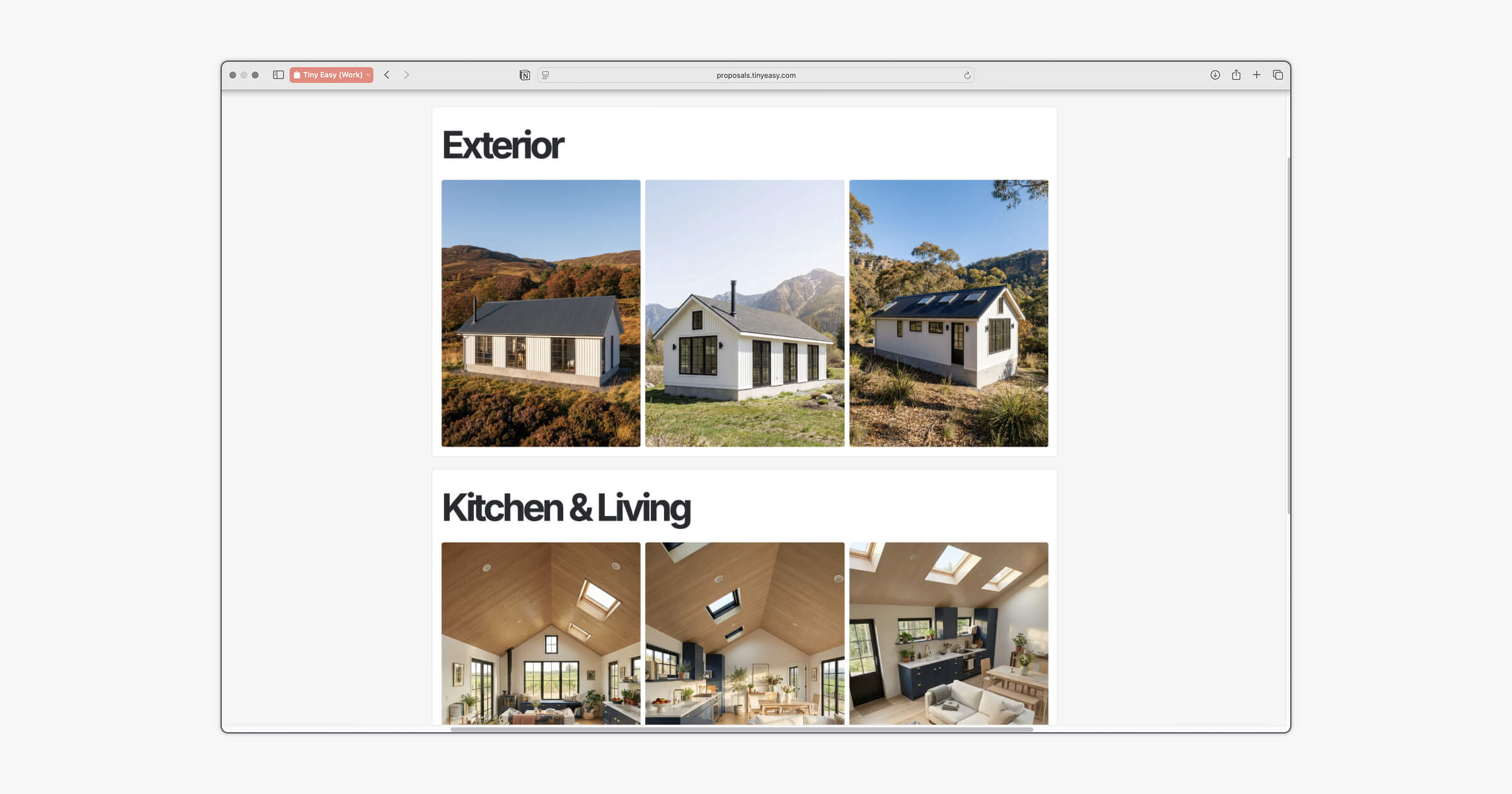
If you're working from a construction proposal and agreement template, this is the section that tends to get the least attention – and it's usually the one that does the most work. A well-structured template gives you the framework, but the visual content you drop into this section is what turns a standard document into something a client actually engages with. Floor plans and renders placed here give the buyer a clear picture of what they're agreeing to before they ever reach the pricing or terms pages.
4. Specifications and Upgrade Options
Detail the scope of work, materials, and specifications, then clearly present the upgrade options available. If you've ever looked at a building construction project proposal sample to benchmark what a strong proposal should include, this section is usually where the biggest gaps show up. Many builders list what's in the base price but leave upgrade options vague or buried, which leads to exactly the kind of back-and-forth that slows decisions down.
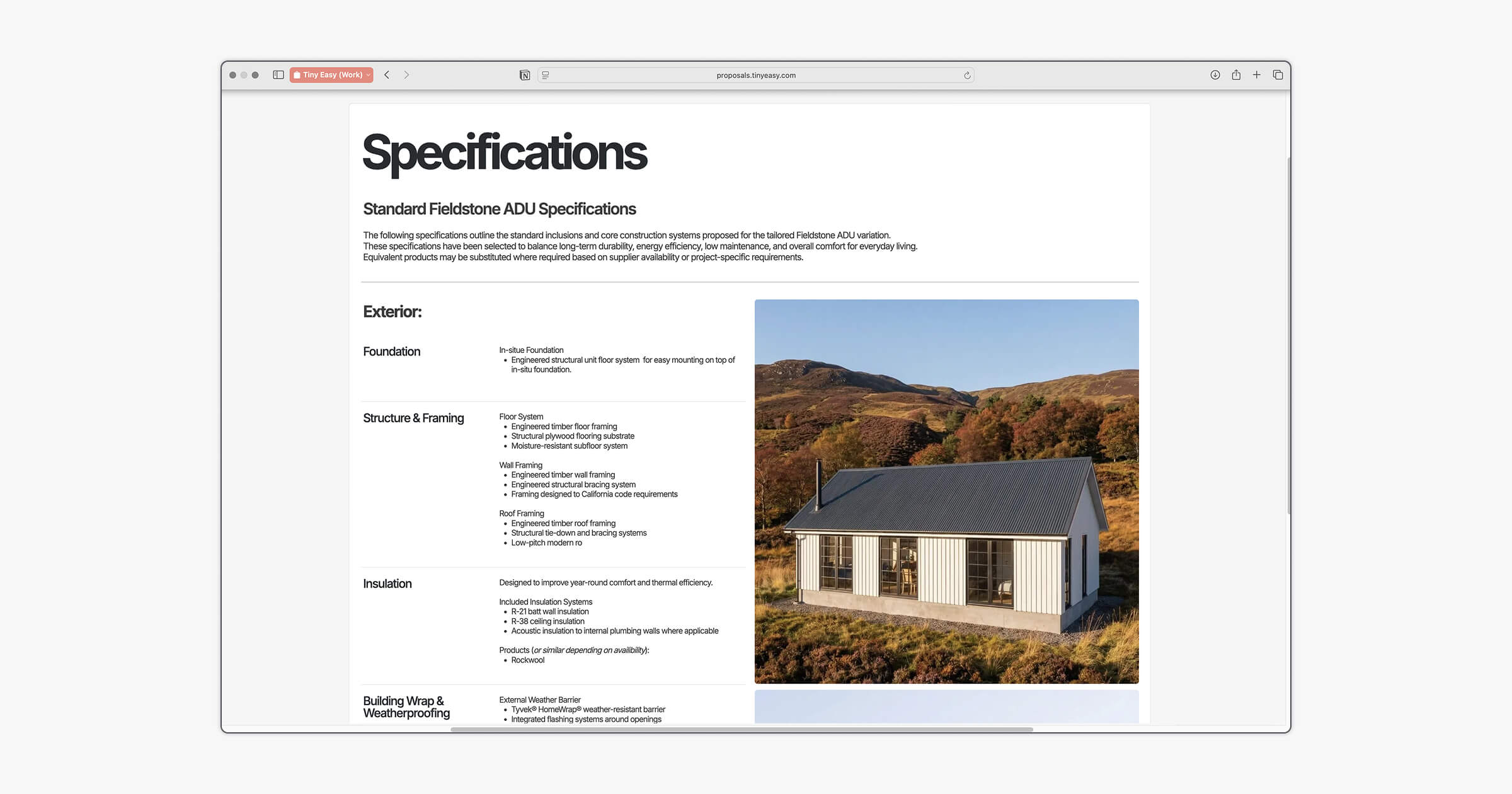
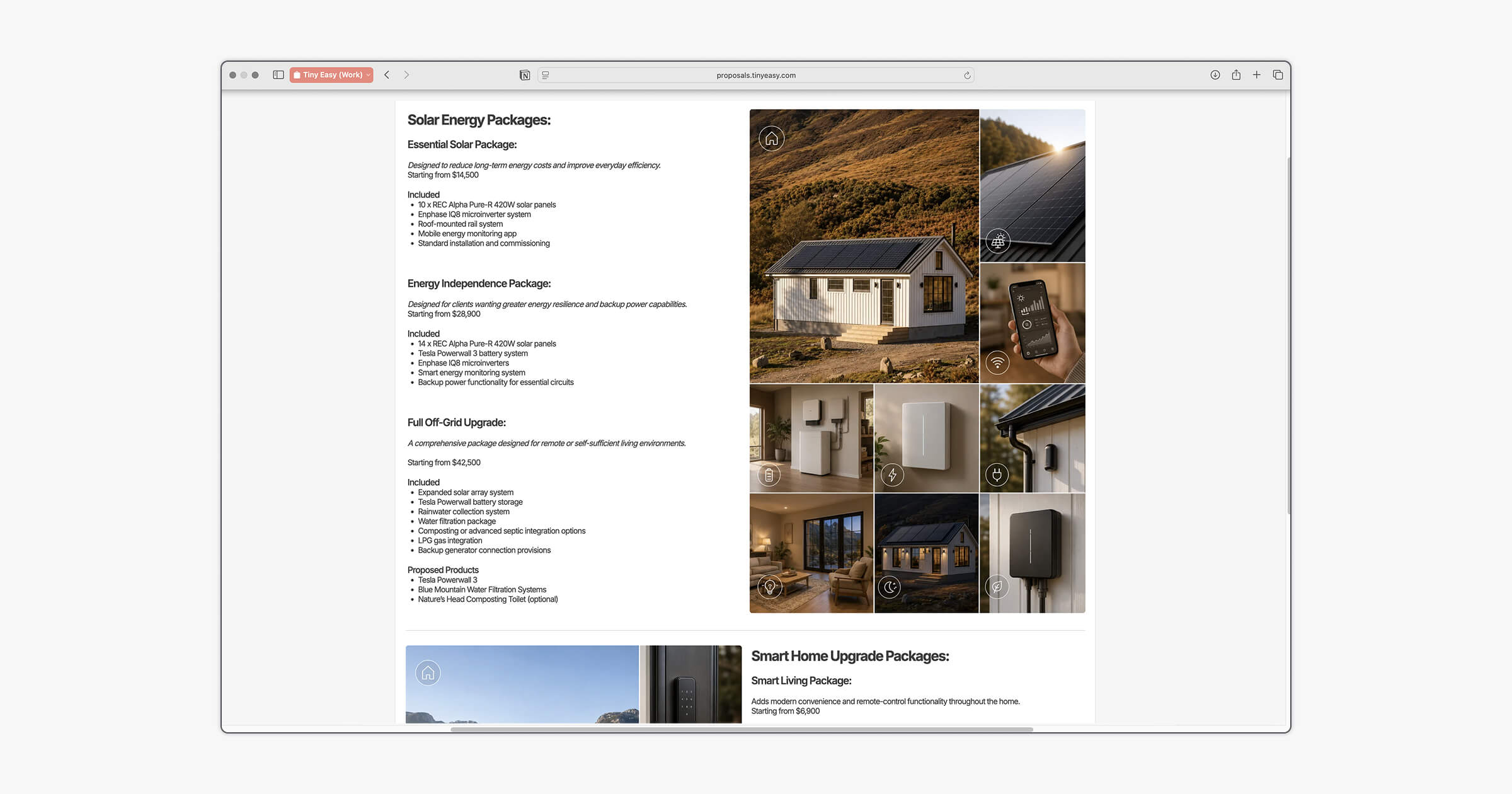
Clients want to know what's included, what they can add, and roughly what each choice costs. Laying that out clearly, whether it's flooring finishes, deck additions, or appliance upgrades, gives buyers a sense of control over the outcome and makes it easier for them to commit without needing another round of emails to figure out what they're actually agreeing to.
"Clients don't just buy your work. They buy peace of mind. And peace of mind starts with a well-prepared quote."
Source: Builder Expert
5. Pricing, Timeline, and Testimonials
This section covers three things that tend to make or break a buyer's decision: pricing clarity, timeline expectations, and social proof.
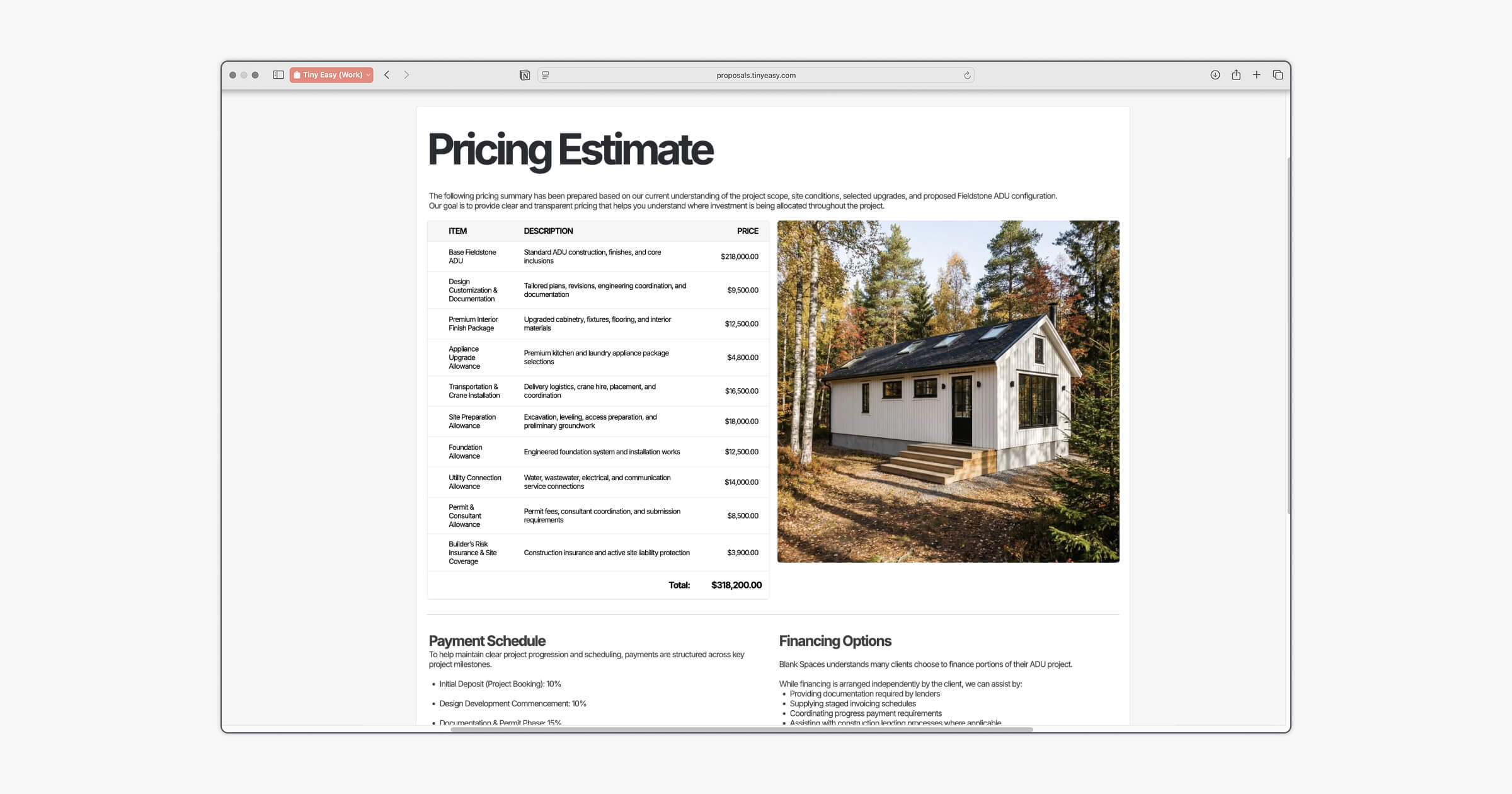
On pricing, be transparent about your process and present indicative pricing in a way that's easy to follow. Clients don't need a final fixed number at this stage, but they do need enough context to feel confident they're in the right ballpark. Break down what's included in the base price, how upgrade options affect the total, and what the payment structure looks like. A good building project proposal example will show pricing in stages: starting price, selected upgrades, estimated total, rather than dropping a single number with no explanation behind it.
For the timeline, walk the client through what happens after they say yes. How long does design finalization take? When does construction begin? What are the key milestones? A realistic, clearly laid-out timeline does two things: it sets expectations early and it signals that you've done this before and know how to manage a project from start to finish.
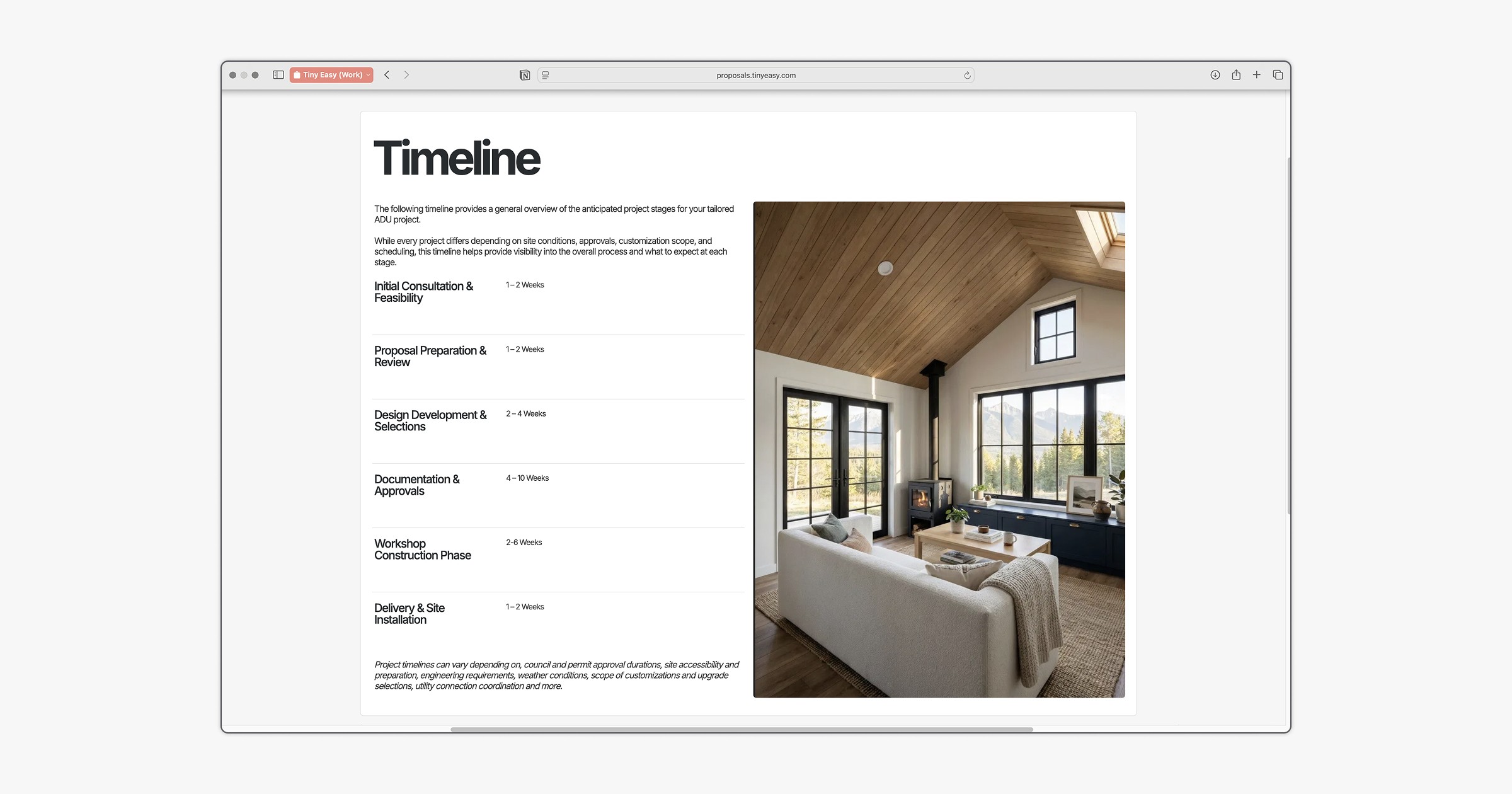
Then back all of it up with testimonials. This is the point in the proposal where the client is weighing their decision most carefully. They've seen the design, reviewed the specs, and now they're looking at the numbers. A short, genuine testimonial from a past client placed here does more than a paragraph of your own copy ever could. It shows that real people have been through this process with you and came out the other side happy.
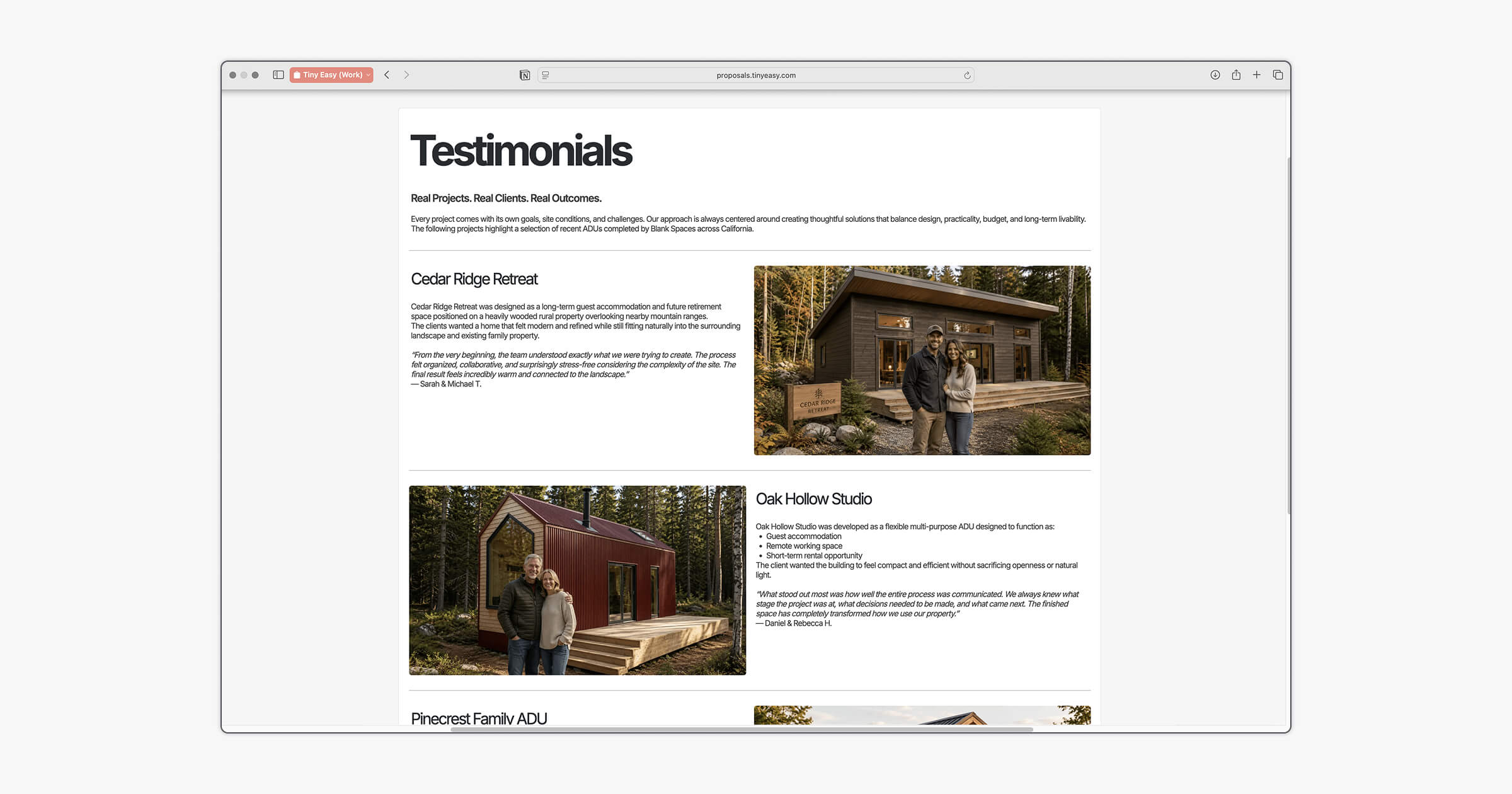
That kind of social proof at exactly the right moment can be the quiet nudge that turns a "we'll think about it" into a signed deposit.
6. Inclusions, Exclusions, and Assumptions
This section is about protecting your margins and managing buyer expectations before a hammer ever swings. When building proposals lack a clear boundary between what’s included and what isn't, it almost always leads to "scope creep" or difficult conversations mid-build.
To keep things professional and easy to scan, use a simple list structure rather than buried paragraphs. Clearly outline:
Inclusions: What the base price covers (e.g., specific finishes, appliances, or trailer types).
Exclusions: What the buyer is responsible for (e.g., site prep, utility connections, or council fees).
Assumptions: The conditions you’re counting on (e.g., flat site access or standard soil types).
Being upfront about these details doesn't scare buyers off–it builds trust. It shows you have a handle on the builder workflow and are proactive about avoiding hidden costs. This level of transparency makes your building proposals a tool for project success rather than just a price tag.
7. Warranty and Terms
Knowing how to write a building construction proposal that holds up after the sale means getting this section right. Include:
Warranty Coverage: Clearly state what's covered, for how long, and what falls outside that coverage.
Payment Terms: Outline terms clearly to avoid confusion.
Contract Conditions: Specify cancellation conditions and any site or access requirements you're counting on.
Assumptions: List any remaining assumptions.
Validity Period: Add a clear expiry date for the proposal, such as 30 days. This helps protect your pricing if material, labour, or supplier costs change before the client accepts.
Keep the language clear and straightforward–clients shouldn't need a lawyer to understand what they're agreeing to. This section sets boundaries and protects both parties, but it doesn't have to feel heavy. A well-written warranty and terms section actually builds confidence because it shows you've thought through the full project lifecycle and stand behind your work. Getting this right early prevents misunderstandings that slow projects down or damage relationships mid-build.
8. Next Steps
End with a clear, simple call to action. What should the client do after reading? Sign here, pay a deposit, or book a follow-up call, whatever it is, make it obvious and easy to act on. If you're working from a construction proposal and agreement template, this is the section that ties everything together.
The template provides the structure, but the next steps you define here are what actually move the buyer from interested to a signed deposit. Keep it short, direct, and specific–one clear action is always better than three vague ones.
The Visual Advantage: How Software for Building Construction Helps Clients Understand Proposals Faster
Text-heavy proposals create a real problem at the worst possible moment. When a buyer is trying to picture their future home and all they have in front of them is a wall of line items and written specifications, the mental work required to connect those words to something real is often enough to introduce doubt and slow the decision down.
That's where visual communication changes the dynamic. When a proposal includes 3D floor plans, exterior renders, and design previews, buyers don't have to imagine the home. They can see it. That shift from abstract to concrete is what moves a client from hesitation to confidence.
If you've ever searched for a building construction project proposal sample to understand what a stronger proposal should look like, one of the most consistent differences you'll notice is how much the better examples rely on visuals to do the heavy lifting. The written content supports the decision; the visuals drive it.
Purpose-built software for building construction makes this genuinely practical for small home builders, especially when the goal is to turn a standard quote into a visual building proposal clients can understand quickly. Rather than stitching together renders, floor plans, and pricing from separate tools, builders can pull everything into one cohesive document, and for standard designs, those visual assets can be reused across proposals without starting from scratch each time.
The result is a proposal that feels professional, is easier for clients to engage with, and gives buyers the clarity they need to move forward without another round of back-and-forth.
Buyers Want to Explore Before They Commit
Today's buyers do a lot of their research before they ever pick up the phone. They're browsing model ranges, comparing layouts, and forming strong preferences well before they reach out to a builder. By the time they're sitting across from you reviewing a proposal, they've already imagined themselves in the home. That shift matters for how you structure your proposal.
A building project proposal example that worked five years ago, a few pages of specs and a price, doesn't carry the same weight with a buyer who's already spent hours exploring designs online. They're looking for something that matches the clarity they've come to expect: real visuals, transparent pricing, and a clear picture of what they're actually committing to.
When your proposal delivers that, with 3D renders, floor plans, upgrade options, and indicative pricing laid out in a logical sequence, it doesn't just inform the buyer. It confirms what they've already started to believe: that this is the right builder, and this is the right home. That's the kind of clarity that removes hesitation and moves a decision forward.
Fewer Questions, Fewer Revisions
Vague or visually sparse building proposals often stall momentum by forcing clients to ask clarifying questions and rely on assumptions. By providing a comprehensive, well-structured proposal that clearly outlines designs, specifications, and pricing, builders can preemptively address client concerns and minimize the need for revisions. Ultimately, this clarity fosters better decision-making, reduces back-and-forth communication, and creates a more efficient transition from the proposal stage to the start of construction.
Visuals Drive Engagement and Emotional Investment
Understanding how to write a building construction proposal that actually moves buyers forward means recognizing that visuals aren't just decoration. They're doing real selling work.
Research from the AEC industry shows that including interactive 3D models in a proposal increases lead engagement time by up to 40% compared to static PDF documents. When clients can interact with a 3D Viewer link, walk through a layout, or see a photorealistic render of their chosen finishes, they're no longer reading a document. They're experiencing a design. That shift matters. A buyer who can picture themselves in the space isn't just engaged. They're emotionally invested. And emotional investment shortens the gap between interested and committed, which is exactly where the proposal needs to do its work. Of course, compelling visuals alone don't make a proposal feel truly professional. How you organize, present, and frame that content matters just as much, which is what the next section covers.
How to Make a Building Construction Proposal Feel More Professional
Getting the core content right is only part of the job. How a proposal is presented matters just as much as what it contains. A well-structured, visually consistent document signals to a client that you're organized, professional, and worth trusting with their project.
One practical way to raise the bar here is to work from a solid construction proposal and agreement template. A well-built template gives you a consistent starting point, one that already has the right sections in the right order, branded to your business, and ready to populate with project-specific details. Instead of rebuilding the document from scratch each time, you're filling in the design visuals, scope details, and pricing for that specific client. That alone can cut proposal preparation time significantly and reduce the risk of missing something important.
Building proposals that consistently win business tend to share a few common presentation qualities:
Follow a logical flow. Guide the client through a clear sequence: introduction, project vision, design visuals, specifications, pricing, and next steps. Clients shouldn't have to search for information or piece together what you're offering.
Keep the visual presentation consistent. Branded colors, logos, fonts, and spacing make a proposal feel intentional rather than assembled from scattered documents. A polished layout builds credibility before the client reads a single line of detail.
Use plain language throughout. Avoid heavy construction terminology when explaining scope, specifications, exclusions, and pricing. If a client has to decode your proposal, you've already created friction in the sales process.
Make it personal, not faceless. Include an About Us section, a short note from the builder, testimonials, or past project examples. Clients are making a significant financial decision, and they want to know who they're working with.
Label your visuals clearly. Renders, floor plans, interactive 3D Viewer links, room visuals, and finish references should all be easy to identify and understand without explanation. If you've invested time in creating strong design presentation, make sure it actually communicates what you intended.
End with a clear next step. Tell the client exactly what to do: book a follow-up call, approve the proposal, select upgrade options, pay a deposit, or move to contract. Leaving this open creates hesitation.
Research from Procore Technologies supports this thinking: proposals delivered within 24 hours of an initial consultation have a 40% higher conversion rate. Speed matters, but so does quality. A proposal that arrives quickly but feels rushed can undermine the confidence you're trying to build.
A professional proposal doesn't just describe the project. It demonstrates how you work. The attention to detail you bring to a proposal tells clients a lot about the attention to detail they can expect on site. And when that proposal is built on a reliable construction proposal and agreement template, you're not just saving time. You're creating a consistent, repeatable experience that reflects well on your business every time.
Even with strong structure and visuals in place, there are still a handful of common mistakes that can quietly undermine otherwise solid building proposals, and those are worth covering before you finalize anything.
Common Mistakes to Avoid in Small Home Construction Proposals
Even a well-structured proposal can lose a client's confidence if it leaves too much open to interpretation. When you're learning how to write a building construction proposal that actually moves projects forward, avoiding these common mistakes matters just as much as getting the content right.
Sending a price without enough context. A number without supporting detail reads as a quote, not a project offer. Do this instead: Surround pricing with scope clarity, inclusions, and design visuals so the number makes sense.
Relying only on technical drawings. Most clients aren't trained to read floor plans. Do this instead: Support technical drawings with 3D visuals, renders, or interior perspectives that communicate spatial flow and finishes clearly. As Hudson Bid Writers note, breaking up dense content with clear headings and visuals significantly improves client comprehension.
Using vague material and finish descriptions. Terms like "builder grade" create mismatched expectations. Do this instead: Name specific finishes, fixtures, and material specifications.
Hiding exclusions or assumptions. Site works, utility connections, permits, and delivery costs left unaddressed create friction later. Do this instead: State exclusions and client responsibilities clearly in their own section.
Making upgrade options confusing. Clients need to understand what's standard, what costs extra, and what decisions remain open. Do this instead: Present upgrade options clearly with straightforward pricing context for each.
Leaving the next step unclear. If a client doesn't know whether to approve, call, or pay a deposit, they'll wait. Do this instead: End every proposal with one specific, obvious call to action.
Using inconsistent formats across proposals. Rebuilding structure each time slows you down and looks less professional. Do this instead: Build a repeatable proposal template that can be adapted without starting from scratch.
Skipping a validity period. Material and labor costs shift. Including a 30-day validity clause, as Buildxact recommends, protects your margins and creates a natural urgency for the client to move forward.
A proposal that leaves clients guessing tends to stall. One that anticipates their questions keeps the conversation moving toward a decision. That's where the right tools can make a real difference.
Stop Chasing, Start Closing: The Tiny Easy Proposal Builder
For many small home builders, the proposal stage is where things slow down. Designs are scattered across email threads, pricing lives in a spreadsheet, and pulling it all together into something client-ready takes more time than it should.
Tiny Easy is built to help fix that. For builders comparing software for building construction sales workflows, it's not a CAD tool. It's a connected sales, design, proposal, and handoff workflow built specifically for small home builders.
The Proposal Builder lets you take everything covered in this guide: the visuals, scope, indicative pricing, upgrade options, timeline, and next steps, and bring it together into a structured, professional document without rebuilding it from scratch each time. If you've been searching for a solid building project proposal example to model your own process on, the Proposal Builder gives you something better: a working framework that's already set up and ready to populate, with your own designs and client details dropped straight in.
Here's how the connected tools support your proposal workflow:
3D Designer: Create and adjust designs, then move them directly into your proposal
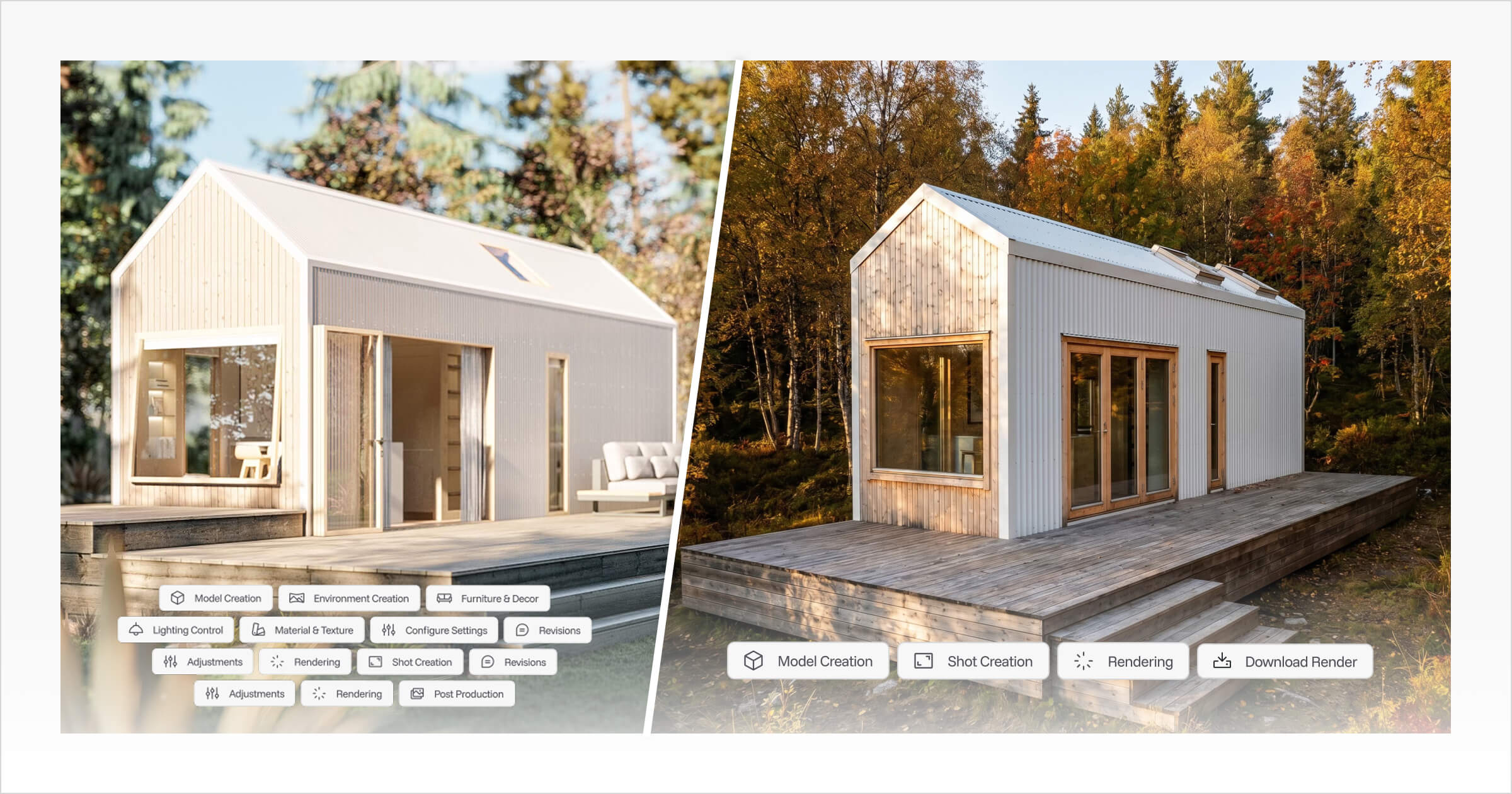
AI Render Tool: Generate polished visuals that bring the design to life for clients
3D Viewer: Share interactive designs clients can explore on any device
3D Configurator: Let buyers visualize upgrade options and indicative pricing before the proposal stage
PDF Sales Plans: Export clean, client-ready plan documents to include with your proposal
According to the JBKnowledge Construction Technology Report, construction companies using integrated sales and design software reduce their lead-to-contract cycle time by an average of 35%. A clearer proposal workflow is a big part of why.
When clients can see the design, understand the scope, and follow the pricing context and next steps clearly, decisions happen faster.
A clearer proposal doesn't just look more professional. It removes the hesitation that slows clients down.
Ready to take your proposal process from weeks to hours? See how Tiny Easy works for builders like you and book a demo today.
Conclusion
A strong building construction proposal does more than explain the price. It helps clients understand the design, trust the process, and feel confident about what they’re agreeing to.
For small home builders, that means moving beyond basic quotes and creating building proposals that clearly show the project vision, scope, inclusions, pricing context, upgrade options, terms, and next steps. When those details are supported by floor plans, 3D visuals, renders, and interactive design previews, the proposal becomes easier for clients to understand and much easier for them to approve.
If you’re learning how to write a building construction proposal, the goal isn’t to create a longer document. It’s to create a clearer one. A good construction proposal and agreement template gives you the structure, but the real value comes from how well you communicate the home, the process, and the decision in front of the client.
This is where software for building construction can make a meaningful difference. Instead of piecing together drawings, renders, pricing, upgrade options, and proposal pages across separate tools, builders can use one connected workflow to create a more professional proposal experience.
Tiny Easy’s Proposal Builder helps small home builders turn their designs, AI renders, 3D Viewer links, pricing context, and project details into client-ready proposals faster. Whether you’re creating your first building project proposal example or improving an existing proposal process, a visual workflow helps clients see the value clearly before they say yes.
Ready to create clearer, more visual building proposals? Book a demo with Tiny Easy to see how our Proposal Builder helps small home builders turn designs into professional proposals faster.
Key Takeaways
Using vague material and finish descriptions. Terms like "builder grade" create mismatched expectations. Do this instead: Name specific finishes, fixtures, and material specifications.
Leaving the next step unclear. If a client doesn't know whether to approve, call, or pay a deposit, they'll wait. Do this instead: End every proposal with one specific, obvious call to action.
3D Designer: Create and adjust designs, then move them directly into your proposal
AI Render Tool: Generate polished visuals that bring the design to life for clients
3D Viewer: Share interactive designs clients can explore on any device



About the Author
Eujenne | Co-founder of Tiny Easy and has 8+ years of experience in the tiny house and small home industry.
She built her own tiny home on wheels with her partner and co-founder Laurin, and has designed several popular Tiny Easy concept homes, including the Scandi, Petite Maison, and 10x10 Tiny House on Wheels. At Tiny Easy, Eujenne works across UI/UX, product education, content marketing, and builder resources, helping small home businesses use 3D design and visual sales tools to improve their design, sales, and client communication workflows.